
You have probably noticed it before you had a name for it. A scene that used to do the job in thirty seconds now takes ten minutes of searching, and even then it barely lands. Or the opposite problem: a real moment with an actual partner, the kind that should register hard, barely registers at all, like someone turned the signal down. Somewhere in that noticing, you likely ran into the phrase dopamine reset, usually attached to advice about deleting apps for a weekend or giving up sugar for a month. You tried some version of it. Maybe it helped, at least for a few days. You are probably not sure why, and most of the explanations attached to the term online are either vague or quietly wrong.
I want to take the phrase seriously, because the observation underneath it is basically correct: constant high-intensity stimulation dulls your response to ordinary stimulation. What gets the explanation wrong is the mechanism, and the correction matters most exactly where the popular dopamine reset content never bothers to go, which is male sexual arousal specifically.
What the Dopamine Reset Idea Gets Right
The modern dopamine reset trend, sometimes called dopamine fasting or a dopamine detox, traces to a specific source: psychologist Cameron Sepah’s 2019 framework, built on cognitive behavioral therapy, aimed at compulsive engagement with phones, social media, junk food, and gambling. Strip away the branding and the underlying claim is not new or exotic. Anyone who has spent a week somewhere with no signal and come back oddly sensitive to a phone buzzing in their pocket has felt a rough version of a dopamine reset already, long before the term existed.
The pattern people report is real and reproducible: after a period of reduced high-intensity input, ordinary things feel more vivid, tasks that felt like a slog become easier to start, and low-key pleasures that had stopped registering start registering again. That is not a story people are telling themselves to feel better about a phone-free weekend. Something in the system that decides what counts as worth paying attention to has genuinely shifted.
Where dopamine reset content consistently falls short is on the sexual side. It gets mentioned in passing, usually lumped in with junk food and gaming as one more compulsive behavior to trim, and then dropped. None of the popular guides explain what a dopamine reset changes in the arousal system specifically, or why sex might respond to overstimulation differently than a news feed does. That gap is where this article is aimed.
Why the Dopamine Reset Doesn’t Work the Way You Think
The literal version of the claim, that dopamine runs low from overuse and needs time to refill like a tank, does not hold up. Your brain is not stockpiling dopamine and spending it down over the course of a scrolling session. What is actually changing looks more like a calibration problem than a supply problem.
A foundational distinction in the reward literature, laid out by Kent Berridge, separates wanting from liking. Dopamine tracks the pull toward a reward, what researchers call incentive salience, not how much pleasure the reward delivers once you actually have it. Wanting and liking run through partly separate systems, and it is the wanting system doing the work whenever a dopamine reset seems to help. A related and earlier finding showed that dopamine neurons fire less for a reward you fully expected and more for one that surprises you, functioning as a prediction signal rather than a pleasure meter.
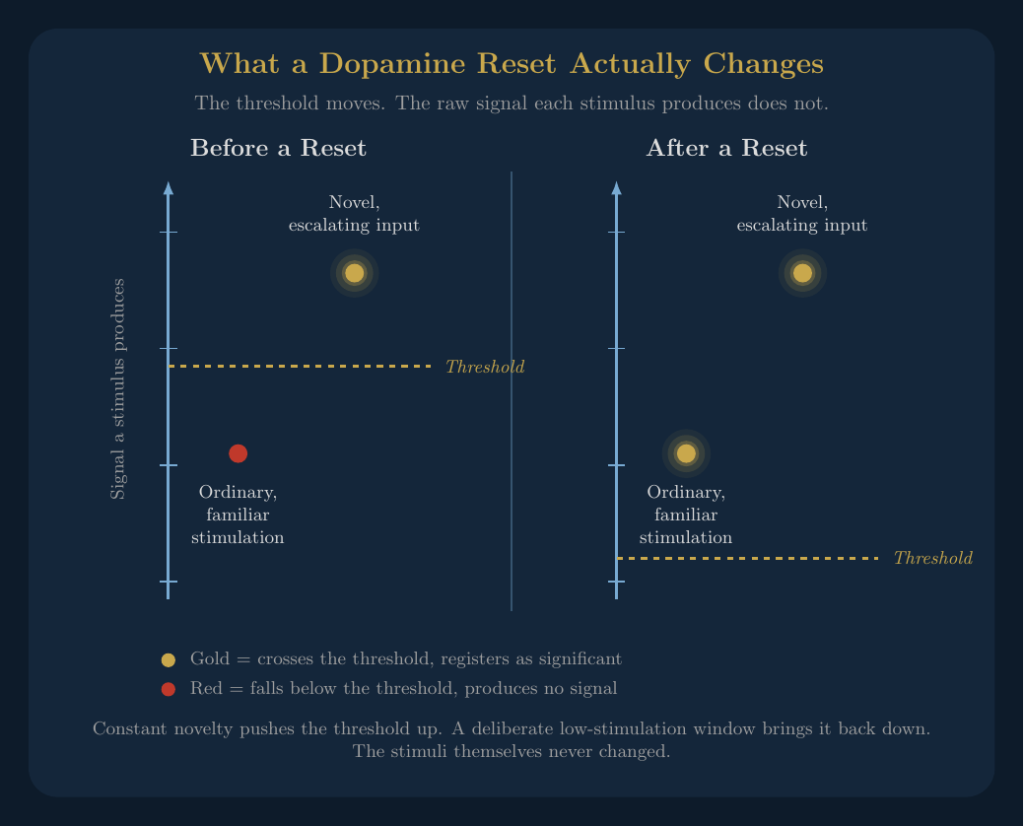
That single reframe changes the entire dopamine reset conversation. If dopamine mostly tracks anticipation and prediction rather than pleasure itself, then flooding yourself with constant, highly novel, highly intense cues does not deplete anything measurable. It recalibrates what counts as surprising enough to register. Ordinary stimulation stops triggering the signal not because you have run out of dopamine, but because the bar for what qualifies as significant has quietly moved upward.
What a Dopamine Reset Actually Restores in Sexual Arousal
In the framework I use, physical arousal, what I call P, is not a fixed function of raw stimulation. How strongly a given input moves P depends on how strongly the anticipatory dopamine system flags that input as worth responding to. That gating step is exactly what a dopamine reset touches, and it is also exactly what generic dopamine reset advice never mentions, because it is specific to how sexual cues work rather than notifications or sugar.
Research tracking the accumbens, the brain region most implicated in cue-triggered wanting, has found dopamine responses driven specifically by sexual cues, and separate work tracking the ventral tegmental area during male sexual behavior has documented dopamine activity that moves with sexual behavior directly, distinct from the general reward signal produced by food or novelty alone. Novelty amplifies that signal. A familiar, repeated cue produces a comparatively muted response next to a new one, which is precisely why an endless supply of varied pornographic material keeps registering long after a single, familiar scene stops doing anything. During an effective dopamine reset, removing that steady stream of escalating novel cues lets the threshold drift back down. A comparatively mild, familiar stimulus, a partner, a plain scene, an ordinary moment, becomes able to produce a real signal again. Not because dopamine “came back,” but because the anticipatory system stopped requiring an ever-bigger surprise before it would fire.
Porn, Novelty, and Why Intensity Keeps Climbing
This is also the honest explanation for what most men would just call porn tolerance: an escalation pattern many recognize but rarely have language for, needing rougher, stranger, or more extreme material over time just to reach the same level of arousal that a much milder scene used to produce without effort. It is not a moral failing and it is not evidence of a broken reward system. It is a predictable consequence of training a system that is built to respond to novelty on a diet made almost entirely of novelty.
I have written before about how frequent, undirected pornography use desensitizes a man’s response over sustained use, and about why deliberate rest before a session makes that session dramatically more effective, in the piece on gooning and extended edging. I have also written about why abstinence sharpens attraction in ways that have nothing to do with the testosterone claims usually cited to explain it, in the comparison between NoFap and this framework. Both pieces are describing the same underlying anticipatory dopamine system this article is naming directly. A dopamine reset, done for sexual responsiveness specifically, is the piece connecting the sexual desensitization those articles describe to the actual mechanism producing it, rather than to a vague sense that something has gone wrong.
How to Actually Run a Dopamine Reset for Sexual Responsiveness
The practical version of this is narrower than most dopamine detox advice suggests, and less extreme. It does not require abandoning arousal altogether, only pulling back from the highest-novelty, highest-intensity end of it for a stretch, long enough for the threshold to drift back down toward where ordinary stimulation can reach it again.
In my own experimentation, the moment that mattered was noticing myself scrolling further than intended, hunting for something extreme enough to actually register, and closing the laptop instead. I went several days without pornography or active novelty-seeking of any kind, while keeping ordinary arousal in the picture rather than treating it as forbidden. Afterward I tested a plain, low-intensity scene the way you might press on a bruise to see if it still hurts. It registered, sharply, the way things used to. That is anecdote about my own physiology, not evidence of anything universal, but it lines up exactly with what the mechanism above predicts: remove the constant supply of novel, escalating cues, and the threshold for what counts as significant comes back down on its own.
Where This Leaves You
A dopamine reset, understood correctly, is not a detox and it is not about eliminating pleasure. It is a deliberate reduction in novel, high-intensity input, long enough for the anticipatory system that gates physical arousal to stop demanding more than ordinary stimulation can provide. For sexual responsiveness specifically, that is a real and useful thing to understand and to do.
It is also a starting point rather than a destination. Restoring your baseline sensitivity tells you the system still works. It does not, by itself, teach you how to deliberately build and direct the sexual tension that a responsive system makes possible in the first place.
If the S/P/M/T model behind that idea, stimulation, physical arousal, mental arousal, and the tension that opens between them, is new to you, the free framework PDF lays out the complete model before any practice begins.
If you already have the model and want the practice built on top of it: the book covers the five observable stages of physical arousal, the mind-body connection behind them, how sexual tension actually accumulates, the tension-release paradox that trips most men up, and two full workflows for reaching what I call Sexual Awakening, backed by a mathematical appendix and simulations for the more analytically inclined. It is written for men who want the reproducible version of this, not the accidental one.
Comments
One response to “Dopamine Reset: What It Actually Restores in Male Sexual Arousal”
[…] have written about this mechanism in detail in the piece on dopamine resets and what they actually restore in sexual arousal, tracing it to the distinction between wanting and liking in the reward literature and to specific […]