You start a session determined to follow the instructions exactly: stimulate, approach the edge, then draw the energy upward instead of pushing through to climax. You stop right where you think you felt something shift. Was that the moment? Did it work? There’s no way to check. Either you tip into ejaculation a few seconds later and conclude you did it wrong, or you don’t, and you’re left just as unsure why.
That was my experience trying to become a multi-orgasmic man using Mantak Chia’s book of the same name. The excitement was genuine. Chia was making a serious claim: that the male sexual response isn’t fixed, that orgasm and ejaculation are separable events rather than one inevitable reflex, and that a man can learn to experience the first without triggering the second. That claim is worth taking seriously, and the multi-orgasmic man tradition deserves credit for building an entire practice on it decades before anyone outside a niche readership was discussing it.
The frustration came later, when I tried to act on it. Everything I needed to understand the mechanism precisely enough to train it was described in language I couldn’t measure. Chi, energy pathways, spiritual cultivation. For someone who needed to know exactly what was happening physiologically, the multi-orgasmic man framework left a critical gap.
This article is about that gap: what the concept gets right, where the explanation falls apart, and what a physiology-based model reveals about the same phenomenon.
What the Multi-Orgasmic Man Gets Right
The central claim of the multi-orgasmic man tradition is that orgasm and ejaculation are two distinct physiological events that happen to coincide in most men’s everyday experience. This is not mysticism. It’s accurate.
Modern sexology backs up the premise. Research on the human sexual response cycle documented that the subjective peak of pleasure and the physical reflex of ejaculation are separate processes occurring in close sequence, not simultaneously, confirming decades later what Taoist practitioners had already worked out through patient self-observation. I’ve written elsewhere about how much the wider Taoist sexuality tradition got right using exactly this kind of first-person observation; the multi-orgasmic man concept is one of its clearest examples. Orgasm is the mental and experiential event. Ejaculation is the physical one. In most men they happen close enough together to feel like a single event. They are not.
If the two are separable, it should be possible to experience orgasm without triggering ejaculation. That’s the practical implication the multi-orgasmic man tradition built its entire practice around, and on that fundamental point, it was right.
Chia’s work also correctly located part of the mechanism in the pelvic floor. Even without the anatomical terminology, his instruction to contract the muscle at the base of the penis to interrupt ejaculation points directly at the PC muscle and its central role in the climax reflex. I go into that muscle in detail in PC Muscle Exercise: Why Relaxation Matters More Than Strength; the short version is that Chia identified the right muscle. And the withholding principle at the core of the practice, that deliberately delaying release lets something accumulate that changes the quality of the eventual experience, is also real. I spent years investigating exactly that phenomenon. The Taoists weren’t inventing it.
It’s also worth being precise about what a multi-orgasmic man practice actually is, because marketing around Chia’s work has muddied this. It isn’t a performance technique for lasting longer with a partner, and it isn’t a claim that men can have unlimited, back-to-back orgasms the way some paraphrased versions of the book imply. What’s real is narrower and more useful: the ability to experience the orgasmic peak, sometimes more than once in a session, without the ejaculatory reflex ending things. That’s a meaningfully different goal from endurance, and confusing the two is part of why so many men come away from Chia’s material frustrated.
Where the Explanation Falls Short
The gap isn’t in what Chia observed. It’s in the explanation stacked on top of it.
Chia explains the mechanism through chi: sexual energy you cultivate, circulate, and redirect through the body along specific pathways. For readers who find that vocabulary useful, it works as a conceptual map. For a reader trying to become a multi-orgasmic man through deliberate, repeatable practice rather than luck, it’s exactly where the tradition stops being useful.
Chi isn’t measurable. I can’t tell you how much of it I have, whether it increased or decreased after a session, or whether I moved it correctly. A concept you can’t measure is a concept you can’t use to check whether you’re improving, and training a precise physical skill requires that feedback loop.
The second limitation is practical. The multi-orgasmic man framework tends to describe what to achieve rather than exactly how to achieve it: stop before the point of no return, draw the energy upward, breathe deeply. These instructions are directionally correct and mechanistically vague. Follow them carefully and you’ll sometimes get the result and sometimes won’t, with limited ability to diagnose which variable you got wrong.
This is precisely the wall I hit. I could follow every instruction in Chia’s book to the letter, stimulate, approach the edge, attempt to draw the sensation upward, and get a different result almost every time. Some sessions produced something close to what he described. Most didn’t, and I had no framework for telling the difference between a session I’d executed correctly and one where the underlying biology simply hadn’t cooperated that day.
The Physiology Behind the Multi-Orgasmic Man
Strip the Taoist explanation down to the observable phenomena underneath it, and two things become clear.
The first is that orgasm and ejaculation are separated by physical arousal level, not energy work. Ejaculation fires when physical arousal crosses what I call the Point of No Return: the threshold at which the pelvic floor begins its involuntary contraction sequence and ejaculation becomes inevitable regardless of what happens next. Orgasm, the subjective peak of pleasure, occurs just before that threshold. The gap between them is small but real, and it’s physiological, not metaphysical.
The second is that the mechanism for staying on the orgasmic side of that threshold is specific. As physical arousal rises toward the point of no return, the body initiates what I call a physical ramp response: involuntary muscle tension, pelvic contractions, interrupted breathing, and, crucially, engagement of the PC muscle. These are the body’s safety valves, and when they fire, they push physical arousal over the threshold toward ejaculation.
Chia was right that muscular intervention can interrupt this sequence. What the multi-orgasmic man tradition gets backwards is the direction. The specific skill isn’t contraction but deliberate relaxation of the PC muscle at the exact moment it wants to fire. That’s the reverse kegel, and it’s the physical mechanism underneath what the Taoist tradition describes in energetic terms. I break the exercise down step by step in Ejaculation Control Exercises, but the short version is that you’re training relaxation, not squeeze.
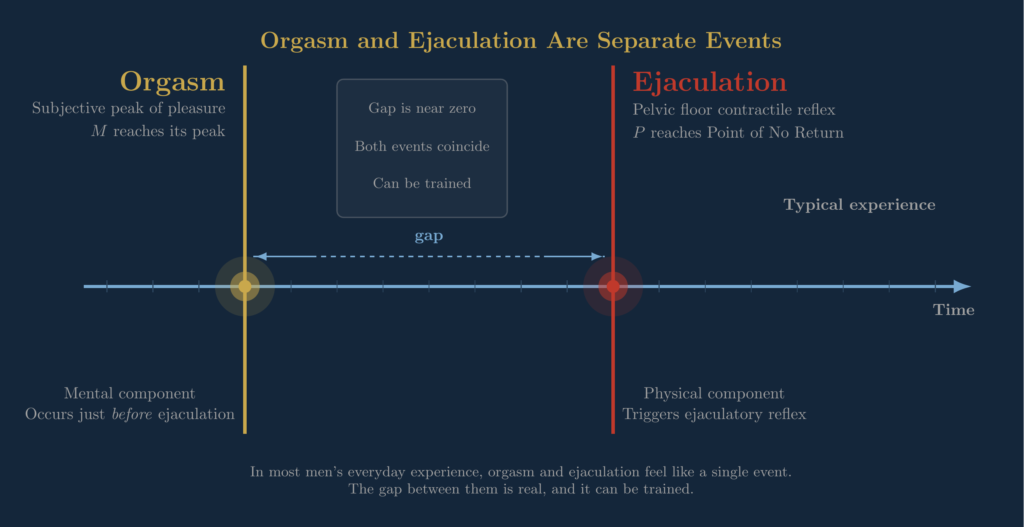
Mental arousal adds the remaining dimension. Physical and mental arousal move together: as physical arousal climbs, mental arousal climbs with it, and as you approach the threshold deliberately, mental arousal surges sharply. That surge is what produces the orgasmic experience itself, the non-ejaculatory orgasm the multi-orgasmic man tradition promised all along. Managing the gap between mental and physical arousal, not the flow of chi, is what lets you stay in that zone instead of tipping into ejaculation.
None of this requires believing in energy circulation. It requires tracking four things you can actually observe: where physical arousal sits, where mental arousal sits, whether the PC muscle is relaxed or contracting, and how close you are to the threshold. Once you’re working with those, orgasm without ejaculation stops being a mysterious skill some men happen to have and becomes something closer to a targeting problem.
Why the Mechanism Matters More Than the Metaphor
This is the practical difference an observable model makes for anyone chasing the multi-orgasmic man result rather than reading about it. With Chia’s vocabulary, a session either works or it doesn’t, and there’s no way to say why. With physical arousal level, mental arousal level, PC muscle state, and the presence or absence of a physical ramp response as your variables, a failed attempt becomes diagnosable. You know which one moved when it shouldn’t have.
Say a session doesn’t go as planned and you cross into ejaculation earlier than intended. With Chia’s model, the only available explanation is that you failed to move the energy correctly, which tells you nothing you can act on next time. With the physiology-based model, you can ask a specific question: did the physical ramp response fire before you caught it, or did mental arousal spike so fast that physical arousal got dragged up with it? Those are two different problems with two different fixes, and knowing which one occurred is most of the difference between a multi-orgasmic man practice that improves session over session and one that plateaus.
That diagnosability is what separates a man who becomes a multi-orgasmic man reliably from one who stumbles into it once by accident and can’t reproduce it. It’s the difference between a practice you can refine and one you can only hope repeats itself.
The specific exercises, the progressions, and the complete model describing how these variables interact are what the book works through in full. This article is about the mechanism the multi-orgasmic man tradition pointed at but never could name precisely; the training protocol itself is a separate, longer conversation.
Where to Go From Here
If the idea that orgasm and ejaculation are separable, physically rather than energetically, is new to you, or you’ve tried to become a multi-orgasmic man before without a way to tell whether you were doing it right, the free framework PDF is the right place to start. It lays out the four-variable model, S, P, M, T, that the Point of No Return and the physical ramp response both sit inside, before any of the practice begins.
If you’re past the concept and want the actual training protocol behind it, the exercises, the progressions, and the workflows for producing non-ejaculatory orgasm deliberately rather than by accident, that’s what the book covers in full.
Comments
One response to “The Multi-Orgasmic Man: What the Concept Gets Right and What’s Missing”
[…] science carried out with a pre-scientific vocabulary. I cover this in more detail in the multi-orgasmic man article, where I look at what the tradition correctly identified about the orgasm-ejaculation […]