I know the arc of monk mode because I have run it on myself, more than once, the way I have run every practice in this book’s orbit on myself before writing about it. Day one is mostly noise: cravings, a phone you keep picking up out of habit, a faint sense that you have made a mistake. By day ten something shifts. The noise thins out. Focus comes easier. By day twenty you feel unmistakably sharper, more awake, more like the version of yourself you were trying to become. And then, for a lot of men running monk mode, day thirty-three happens. One slip. A single relapse. And within a night, not just the discipline but the entire sense of progress collapses with it, sometimes leaving you feeling worse than before you started.
If you have lived that arc, I want to tell you plainly: the crash is not proof that your willpower was fake. It is a predictable output of how monk mode is structured, and understanding why will change how you run it.

What monk mode gets right about discipline and arousal
Before I get to where monk mode breaks down, I want to credit what it identifies correctly, because on the substance, a lot of it holds up.
The core claim of monk mode is that stripping out constant stimulation, pornography, endless scrolling, junk food, aimless socializing, changes something real in you. That is not motivational mythology. Reducing chronic exposure to high-frequency stimulation does measurably shift sensitivity and attentional control, and most men who commit to monk mode for even two or three weeks report the same cluster of effects: sharper focus, a return of anticipation and desire that felt dulled before, and a kind of clarity that is hard to fake. The self-reports across these communities are remarkably consistent on this point, and consistency across thousands of independent, unconnected reports is itself a signal worth taking seriously.
Monk mode also gets the mechanism half right without quite naming it. What most people mean by nofap monk mode is really two overlapping practices stacked together: a set of monk mode rules governing diet, sleep, screen time, and social contact, layered on top of the specific sexual abstinence I cover in more direct terms in the NoFap article on this site. That article makes the case that abstinence from masturbation and pornography allows sexual tension to accumulate instead of being discharged the moment it appears. Monk mode simply widens that same principle outward, stripping distraction from every domain at once rather than just the sexual one. The instinct is sound. Constant low-grade release, whether of sexual tension, dopamine from a feed, or attention from a notification, keeps a man in a permanently discharged, low-intensity state. Remove enough of those release valves at once and intensity returns across the board.
None of this is metaphysics or hype. It is a genuine, observable effect of sustained abstinence and reduced stimulation, and men who run monk mode seriously are not imagining the sharpening they feel in the first few weeks. The reported monk mode benefits, sharper attention, a return of appetite and drive, a feeling of having more room in your own head, show up consistently enough across independent, unconnected accounts that they deserve to be taken as real data rather than dismissed as placebo or motivated reasoning. What varies is not whether the effect exists, but how long it lasts and what happens once the count of monk mode days gets high enough that a lapse becomes statistically inevitable.
Where monk mode loses the thread
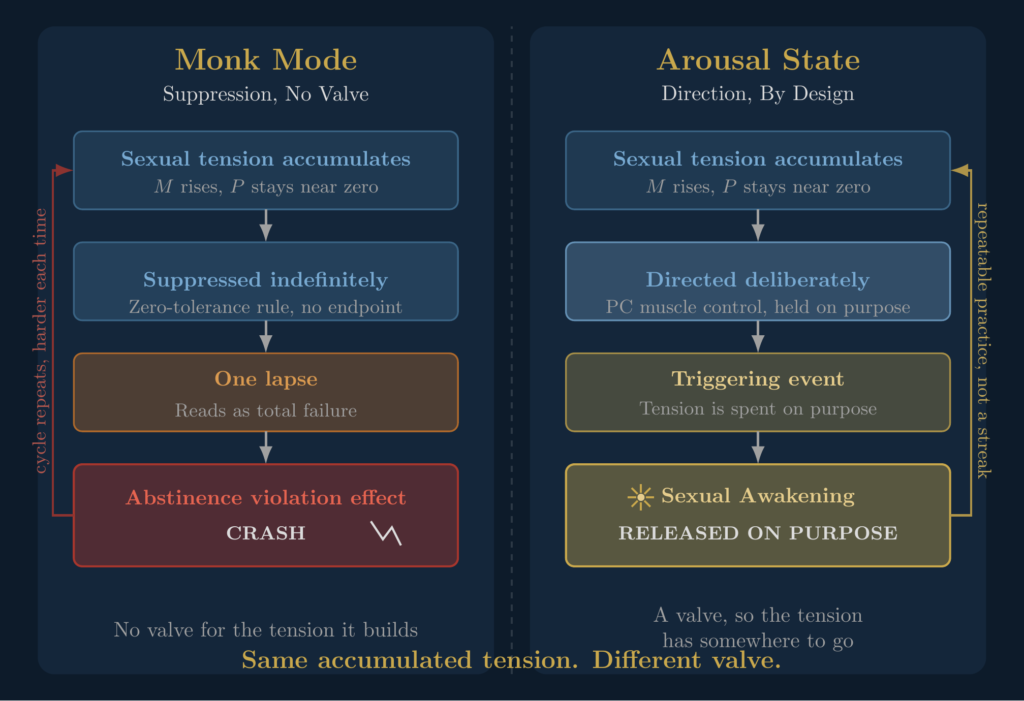
Here is the precise gap. Monk mode treats sexual tension, and stimulation generally, as an enemy to be eliminated rather than a resource to be directed. The rule is total: no porn, no masturbation, no edging, no peeking, for a fixed and often lengthy stretch, with a single slip counted as total failure of the entire attempt.
That all-or-nothing framing is not a minor stylistic choice. It is the exact structural condition that relapse psychology has spent decades studying under a specific name: the abstinence violation effect. In the cognitive-behavioral model developed by Marlatt and colleagues, a lapse and a full relapse are meaningfully different events, but a rigid, zero-tolerance framework collapses that distinction. When someone holding an absolute abstinence goal experiences even one lapse, the reaction is disproportionate: guilt, a sense of total failure, and a collapse in self-efficacy, which in turn makes a much larger relapse more likely, not less. A widely cited overview of the relapse-prevention literature lays this out clearly: it is the emotional and cognitive reaction to a lapse, the guilt and the sense of having failed completely, that predicts whether a single slip turns into a full relapse, not the lapse in isolation. Swap “drinking” for “watching porn” or “masturbating” and the mechanism transfers directly. A man following strict monk mode rules with a single-lapse-equals-failure standard has built himself a framework that manufactures exactly the emotional conditions most likely to produce a total collapse.
This is the part almost nobody running monk mode has language for. The day-thirty-three crash is not evidence that the man lacked discipline. It is evidence that his framework gave him nowhere to put a lapse except into the category of total failure, which is precisely the psychological trigger that turns a small slip into a full collapse. The practice, as most men run it, has a start line and an all-or-nothing scoreboard, but no valve.
The reframe: tension is fuel, not an enemy
Here is the piece that changes everything once you see it. During a strict monk mode stretch, your mental arousal, your desire, your anticipation, climbs steadily while your physical arousal stays near zero because nothing is triggering it. That widening gap between the two is what I call sexual tension, and it is the same T = M − P relationship this site’s framework is built around. This produces a textbook accumulation of T. That is exactly why the clarity and intensity men report in week three or four is real. What it does not do is give you any deliberate outlet for that accumulated tension, so it either leaks out in an uncontrolled slip that spirals through the abstinence violation effect, or it gets discharged all at once with nothing gained from having built it.
Arousal State treats that same accumulated tension as fuel rather than a liability. Instead of a single absolute rule applied indefinitely, the practice is to build tension deliberately and then direct it toward a specific outcome, a session, an Awakening, rather than suppressing it and hoping it never leaks. That requires one physical skill monk mode never teaches: control over the pelvic floor valve that determines whether rising arousal continues climbing toward release or gets deliberately held. I cover this in detail in the PC muscle and reverse kegel article, but the short version is that relaxing this muscle at the moment it wants to contract is what actually gives you command over accumulated tension, instead of leaving you dependent on willpower alone to keep a lid on it.
There is also a rest principle buried inside monk mode that is worth pulling out and using correctly. Periods without masturbation or pornography genuinely do restore sensitivity, and that is real. But monk mode applies this insight as a permanent, open-ended state rather than a deliberate, cyclical one. In my own practice, and in the framework this site teaches, rest periods are used the same way an athlete uses a taper: a bounded window with a clear purpose, followed by a return to deliberate practice, not an indefinite hold with no release valve and no plan for what happens when the tension peaks.
Running monk mode without the crash
None of this means abandoning monk mode’s core instinct. The instinct, that removing constant stimulation restores sensitivity, focus, and intensity, is correct, and I would not tell any reader to stop valuing discipline. What changes is the scoreboard. Instead of one absolute rule stretched out indefinitely with a single slip counted as total failure, treat a monk mode window the way this framework treats any period of accumulation: bounded, deliberate, and aimed at something specific rather than open-ended suppression aimed at nothing in particular.
A man who understands that his rising intensity in week three is accumulated sexual tension, not just vague motivation, is in a completely different position than one who is white-knuckling an abstract rule. He knows what he is building, he has a physical skill for directing it rather than merely containing it, and a single lapse does not have to mean the whole structure comes down, because the goal was never indefinite suppression in the first place. That is the difference between running it as an abstract rule and running it as fuel for something you actually get to use.
Counting monk mode days the way NoFap streaks get counted also deserves a second look. A running tally with no endpoint is exactly the structure that produces an all-or-nothing scoreboard, since every day only adds to what a single lapse would destroy. A bounded window with a defined purpose changes the psychology entirely. You are not protecting an abstract streak from ruin; you are accumulating tension toward something specific, and once you understand what that tension is and how to direct it, the count itself stops being the point.
If you want the complete four-variable model behind sexual tension, T = M − P, and how it governs everything I have described here, that is exactly what the free framework PDF covers. It is a one-page analytical summary written for a reader who thinks the way you do. Start there.
If you already want the full practice, the exercises and workflows that turn accumulated tension into something you can direct on purpose instead of merely surviving, the book is where it lives.