You have probably memorized the statistic before you ever thought to question it: seven days without ejaculating, and testosterone jumps by something like 45 percent. It gets repeated across forums, in videos, in the sidebar of the NoFap subreddit, as though it were settled physiology. You may have also felt the other half of the NoFap experience, less discussed but just as real: the specific shame that shows up on day four when you give in, reset the counter to zero, and feel like you have failed at something you do not fully understand.
I want to address both halves honestly, because they deserve different treatment. The tension-accumulation observation at the center of NoFap is genuine, and I will explain the actual mechanism behind it. The testosterone claim used to justify it is much weaker than it appears. And the shame attached to “failure” is worth examining rather than absorbing. Once those pieces are untangled, the relationship between NoFap and what I call Arousal State becomes much clearer: not two competing versions of the same idea, but two different responses to one real physiological phenomenon.

What NoFap Gets Right About the Male Body
Strip away the folklore, and NoFap is built on one solid observation: interrupting the habitual cycle of stimulation and release changes how a man’s body responds to his environment. Attraction feels more acute. Awareness sharpens. The world registers more vividly than it does immediately after a routine release.
The mechanism behind this is not mysterious, and it is not primarily hormonal. Sexual tension, in the framework I use, is what accumulates when stimulation continues without its habitual outlet. Under ordinary conditions, the body defaults to a ramp-and-release cycle: arousal rises, ejaculation follows, and tension never has the chance to build. When a man stops masturbating, he interrupts that cycle. Stimulation still happens. The release does not follow it. Over days, something accumulates, and that something changes how he experiences arousal when it does show up.
There is also a real neurobiological piece here, separate from testosterone. Research on sexual motivation points to dopamine and anticipation as the more credible drivers: anticipating a sexual encounter reliably increases dopamine activity, while the encounter itself temporarily suppresses it, and abstinence allows that system to recover or even sensitize. That is a more defensible explanation for why abstinence sharpens attraction than any hormone-spike theory, and it lines up with what NoFap practitioners actually report feeling.
The Testosterone Study Behind NoFap’s Core Claim
The day-seven statistic traces to one specific paper: a small 2003 study of 28 men, which reported testosterone reaching roughly 145 percent of baseline on the seventh day of abstinence before returning to normal shortly after. It is the single most repeated piece of evidence in NoFap communities, and it deserves more scrutiny than it usually receives.
Two things are worth knowing about it. First, the study was retracted in 2021, not for fraud, but because the same data had already been published in a Chinese-language journal years earlier, a violation of publication ethics rather than a problem with the underlying data. Second, and more importantly, the finding was never independently replicated at meaningful scale. Larger studies examining the same question, including work by Exton and colleagues and by Isenmann and colleagues, found testosterone levels stayed comparatively stable across abstinence periods, with only minor fluctuations, not the dramatic spike the original paper reported. A peer-reviewed review of the ejaculation-frequency literature reached a similar conclusion: the evidence connecting abstinence to elevated testosterone is considerably thinner than the claim’s popularity would suggest.
None of this means abstinence does nothing. It means the specific mechanism most often cited to explain what NoFap practitioners feel is probably not the right one. The dopamine and anticipation research above is the more solid explanation, and it does not require testosterone to do any of the work.
Where NoFap’s Failure Framing Becomes a Problem
The same review that examined the testosterone claim also looked at what predicts a man’s motivation to abstain in the first place, and the finding is worth sitting with. Motivation to practice abstinence tracked most closely with how harmful a man already believed masturbation to be, not with any physiological or behavioral marker. The belief tends to come first. The practice follows it.
This matters because a large part of NoFap culture is organized around a streak counter, and a reset after ejaculation gets routinely described as a relapse or a failure. I want to be direct about why I think that framing causes a real problem: masturbation is not an addiction, an injury, or a moral lapse for the overwhelming majority of men who engage in it, and treating a normal physiological event as a personal failure builds shame into a practice that did not need it. A man can want to reduce compulsive pornography use, which is a legitimate and achievable goal, without treating every ejaculation along the way as evidence that he has failed at self-control.
Where NoFap and Arousal State Diverge
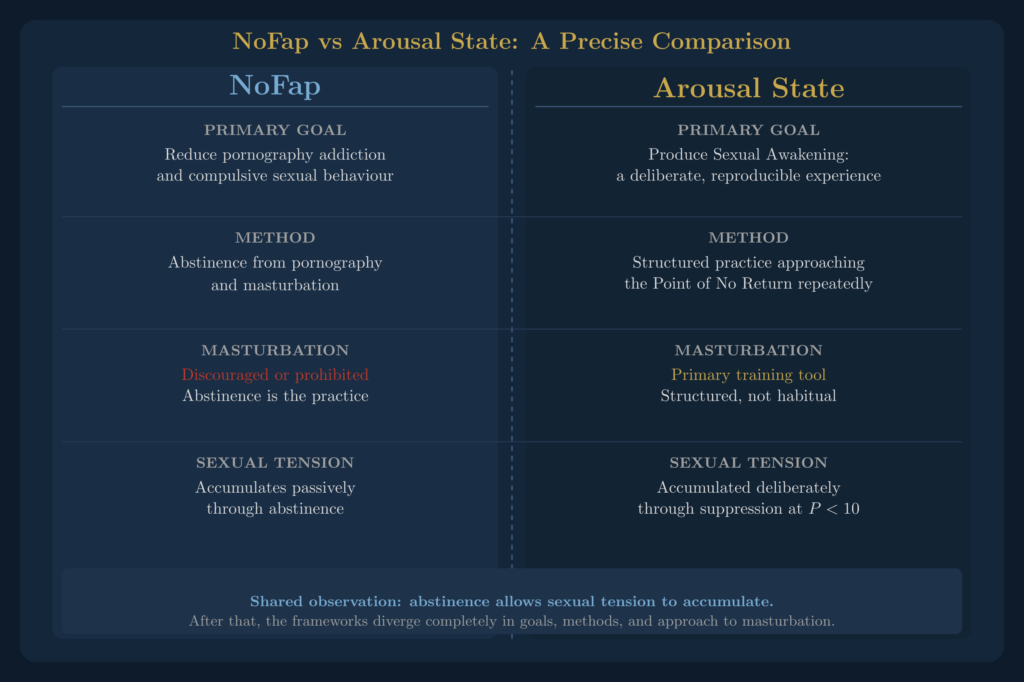
This is where the two approaches genuinely part ways, and it runs deeper than differing goals. NoFap’s method is subtraction: stop, or dramatically reduce, and treat every lapse as a setback. The Arousal State framework uses masturbation as its primary training tool, not something to avoid or feel guilty about.
Specifically, it uses the practice of approaching the Point of No Return, the physical threshold at which ejaculation becomes inevitable, and pulling back before crossing it. The edging technique this relies on accumulates sexual tension through repeated approach and withdrawal, rather than releasing it through avoidance. Each session builds toward a specific outcome I call Sexual Awakening: a sudden, whole-body surge of sensation, not a mood shift or a gradual improvement, but an unmistakable physical event most men never learn to access deliberately.
A NoFap practitioner and an Arousal State practitioner are, physically, doing close to opposite things. One avoids sexual activity to prevent the habitual release. The other engages in structured sexual activity specifically to build tension through controlled suppression. Neither goal is wrong. They are answering different questions, and only one of them treats ejaculation as a neutral, resettable variable rather than a scoreboard.
The Shared Mechanism, and Why Reproducibility Matters
Both pathways can produce a state in which accumulated tension releases suddenly and overwhelmingly when the right trigger occurs. Abstinence accumulates tension passively, by removing the habitual outlet and waiting. Deliberate practice accumulates it actively, by training the suppression response at the precise moment it matters, which is why it tends to build tension faster and more reliably than passive waiting alone.
The difference is reproducibility. Passive abstinence depends on waiting long enough and then encountering the right circumstance largely by chance. This is why some long-term NoFap practitioners describe occasional overwhelming experiences they cannot explain or repeat on demand: they have accumulated fuel without a map of the ignition mechanism. Learning to work the PC muscle deliberately, relaxing it at the exact moment it wants to fire instead of only strengthening it, is a large part of what that map consists of, and it is a skill built through practice rather than inherited from time alone.
What Actually Moves Testosterone
If testosterone and general vitality are the real goal behind an abstinence practice, and for many men I suspect they are, the interventions with genuine evidence behind them have little to do with counting days since your last ejaculation. Regular resistance training raises testosterone acutely and helps sustain higher baseline levels over time. Body composition matters independently of abstinence: elevated body fat, particularly visceral fat, correlates inversely with testosterone. Diet plays a measurable role too. Diets that are too low in fat suppress circulating testosterone, since cholesterol is the precursor molecule for steroid hormone production, while adequate zinc and vitamin D intake are both associated with healthier hormone profiles.
None of these interventions are dramatic in isolation, and none will out-perform a man’s individual biology. But collectively, they do more verifiable work for hormonal health than abstinence alone, and they do it whether or not a man is also practicing tension-building exercises.
The Question of Pornography
One more point worth stating clearly: the Arousal State framework takes no moral position on pornography, but it does take a practical one. High-intensity pornographic stimulation tends to shortcut the accumulation process, driving rapid arousal and release rather than the slow buildup deliberate practice requires. A man trying to build sexual tension through structured sessions will find pornography works against him, not because it is wrong, but because it makes the suppression skill much harder to practice. Lower-intensity mental stimulation, allowing arousal to rise slowly while physical arousal is managed deliberately, tends to work better for this specific purpose. This is one place where NoFap’s instinct about pornography is practically useful, even where the underlying goal differs.
Is NoFap Right for You
If your goal is reducing compulsive pornography use or resetting a habit that has become difficult to control, NoFap’s community and structure remain a reasonable resource, and I would encourage dropping the streak-shame framing while using it. If your goal is understanding what your body is capable of experiencing, specifically a reproducible, overwhelming physiological state most men never learn exists, that is what Arousal State addresses, and it requires structured practice rather than open-ended waiting.
Some men will find genuine use in both at different points. A short period of reduced activity can establish a baseline before shifting toward deliberate practice. What matters is not confusing the two, and not importing NoFap’s failure framing into a practice where release, at the right moment, is the entire point rather than the thing being avoided.
Where to Go From Here
If sexual tension, the Point of No Return, and the conditions for Sexual Awakening are new concepts, the free framework PDF walks through the complete model before any practice begins.
If you are past the concept and want the training itself: the exercises, the progressions, and the complete method for producing this deliberately rather than by chance, that is what the book covers in full.
I get asked about NoFap more than almost any other topic on this
Comments
4 responses to “NoFap and Arousal State: Two Different Goals, One Overstated Claim”
[…] practice that produces something beyond the session itself, the same redirection I describe in the NoFap comparison on this site, where abstinence alone is never the goal, only the setup for […]
[…] contact, layered on top of the specific sexual abstinence I cover in more direct terms in the NoFap article on this site. That article makes the case that abstinence from masturbation and pornography allows […]
[…] I have written the full breakdown of that claim, and what actually does move testosterone, in the NoFap article on this site, since it deserves more room than a paragraph […]
[…] have covered what NoFap practitioners correctly observe about this mechanism, and where the testosterone explanat…, separately. The short version: what a period of abstinence actually restores in male sex drive […]