Every book on Taoist sexuality points at the same phenomenon and then gives you instructions you cannot verify. Circulate the energy. Move it along the meridians. Transmute it. For some readers that language is enough. For me, it was the wall between curiosity and any real progress.
I had found my way to the shelf (Taoist Secrets of Love, The Multi-Orgasmic Man, The Tao of Sexology), drawn in by three claims that an analytical reader wants to believe: that withholding has value rather than being a missed opportunity, that orgasm and ejaculation are not the same thing, and that arousal builds through distinct recognisable stages. These ideas imply structure, and structure is something you can work with. The frustration was that the books on Taoist sexuality never told me what to do with that structure in terms I could measure.
This article is about what I found when I decided to keep every phenomenon the tradition pointed at and throw out only the part I couldn’t measure.

What Taoist sexuality got right, centuries before Western science
Before I get to where the framing broke down for me, I want to give the tradition its due, because on the substance it was often correct, and in at least one case correct centuries before Western science caught up.
Take the distinction between orgasm and ejaculation. In most men’s everyday experience these feel like a single event, because they happen almost simultaneously. The Taoist sexuality tradition insisted they were separable: that the subjective peak of pleasure and the physiological reflex of expulsion are two different processes. For a long time this looked like mysticism. Then, in 1966, Masters and Johnson published their landmark research on the human sexual response cycle, and Western sexology formalized the same separation. The tradition had identified, through patient first-person observation, something a modern laboratory would only confirm much later.
The staged build of arousal holds up similarly well. The Taoist model describes arousal climbing through recognizable phases rather than leaping straight from rest to climax: lengthening, swelling, hardness, heat, and the point of no return. Strip away the terminology and what’s being described is a real physiological progression: increasing blood flow, rising sensitivity, the body shifting through gears as it approaches its threshold. Once you know to look for it, you can observe it in yourself.
And withholding, the idea at the center of so much of Taoist sexuality, points at something genuinely real about how anticipation works. We all know intuitively that the wait can intensify the reward. The Taoists built an entire practice around that observation. They were not wrong that something accumulates when release is delayed.
Where Taoist sexuality lost me: you can’t measure energy
So if the observations were sound, what was my problem? It was the explanatory layer sitting on top of them.
The tradition explains all of this through “energy”: chi, channelled along meridians, gathered in centres, refined and redirected through what some texts call sex transmutation. I want to be careful here, because it’s easy to be dismissive and I don’t think dismissiveness is warranted. The people who developed Taoist sexuality were doing something serious. They were studying an experience that can only be observed from the inside, and they built a vocabulary to describe it. That isn’t superstition. It’s first-person science carried out with a pre-scientific vocabulary. I cover this in more detail in the multi-orgasmic man article, where I look at what the tradition correctly identified about the orgasm-ejaculation distinction.
The problem is purely practical. I cannot measure chi. I cannot tell you how much of it I have, whether it went up or down, or whether I moved it correctly. A concept I can’t measure is a concept I can’t act on with any precision, and one I can’t use to check whether I’m improving. For a reader who wants reproducibility, who wants to do the same thing twice and get the same result, an unmeasurable quantity is a dead end. Not false, necessarily. Just unusable.
That, for me, was the whole difficulty with Taoist sexuality as a genre. Studying your own arousal is hard enough as it is: you are the instrument and the experiment at the same time, with no external readout to check yourself against. Wrapping the few things you can observe inside a vocabulary of forces you can’t only widens the gap between reading about the practice and actually doing it.
Taking Taoist sexuality apart: the same phenomena, made observable
The move that changed everything for me was simple to state and hard to execute: keep every phenomenon Taoist sexuality pointed at, and throw out only the part I couldn’t measure. Replace “energy” with things I can actually observe.
On the physical side, that turns out to be straightforward. Arousal has visible, trainable correlates: blood flow, the involvement of the pelvic floor (the so-called PC muscle, which you can learn to sense), and the broader nervous system that drives heart rate, breathing, and muscle tension as you climb. None of this requires metaphysics. It is anatomy and physiology, and it is observable in real time. The edging article on this site covers how to use this awareness to build sexual tension deliberately, using the same mechanism that Taoist sexuality describes in energetic terms.
The psychological side is subtler but just as concrete. Modern psychology has a well-established principle called the mind-body connection: mental states and physical states influence each other continuously, in both directions. Stress tightens the body; deliberately relaxing the body calms the mind. That two-way street is the real mechanism underneath much of what the tradition attributed to “energy.” What Taoist sexuality describes as cultivating and circulating is, in observable terms, learning to manage the relationship between two quantities that most men never try to separate.
And the engine driving the whole thing can be stated in plain terms: tension is desire minus fulfilment. Picture an unopened gift sitting in front of you. The wanting, held against the not-yet-having, is exactly the pressure that builds. Resolve it and the pressure drops; sustain it and the pressure grows.
Here is the one insight I’ll leave you with, because it’s the hinge everything else turns on. Arousal is not a single quantity. It has a mental side and a physical side, and this is the part most men never notice: the two don’t have to move together. They can pull apart. Once you can see them as separate, the tradition’s talk of “cultivating” and “circulating” stops being mystical and starts being mechanical. You’re not moving energy around your body. You’re managing the distance between two things you can actually observe.
I’m deliberately stopping there, because that single distinction is the doorway, and walking all the way through it is what the rest of the framework is for.
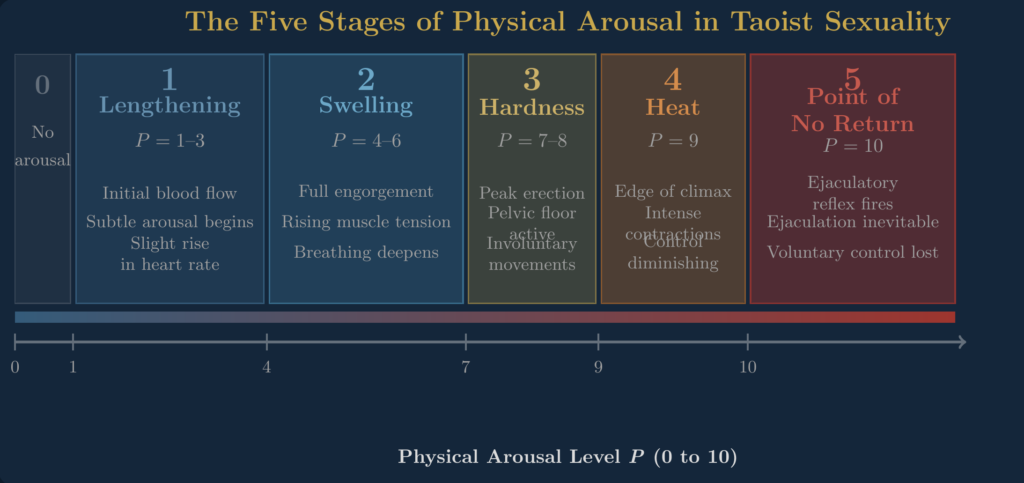
What changes when Taoist sexuality becomes something you can actually measure
None of this makes Taoist sexuality wrong. If anything, translating it into observable terms is the highest compliment I can pay it: the observations were real enough to survive having the metaphysics stripped out.
What changes is what you can do with it. A concept you can observe is one you can track, and one you can track is one you can learn to influence on purpose. That is the difference between reading about sex transmutation and actually being able to study what is happening in your own body in real time, which is what I set out to do, and what took years of careful experimentation to work out.
The hinge insight is the one I stopped at deliberately: arousal has a mental dimension and a physical dimension, and they can pull apart. That single recognition is what makes the rest of the framework possible. Once you can see them as separate, you can manage the distance between them rather than hoping something accumulates by accident.
What I have not told you yet is what happens when that distance gets wide enough, and what kind of event releases it. That is where the framework gets interesting, and that is what the book is for. What I can tell you is that Taoist sexuality was right that something important lives in that zone, they just never had a name for it that an analytical reader could act on.
If the M/P separation is new to you and you want the complete four-variable model before going further (S, P, M, T, and the single relationship that connects them), that is exactly what the free framework PDF covers. It is a one-page analytical summary written for a reader who thinks the way you do. Start there.
If you already want the full practice (the physiology, the exercises, and the workflows that turn the model into something reproducible), the book is where it lives.