You got worked up and didn’t finish, and now there’s a dull, heavy ache sitting low in your testicles that won’t quit. You searched it, and the internet had a name ready: blue balls. Every page agrees it’s real, mostly harmless, and fixable by one of three things. Ejaculate. Cold shower. Wait it out.
What those pages leave out is that the ache is congestion, blood that arrived while you were getting aroused and hasn’t drained back out yet, and ejaculating is one way to drain it, not the only one. There’s a smaller release sitting between enduring the ache and finishing completely, and it clears the discomfort while leaving most of what you spent the last hour building right where it is.
Where Blue Balls Comes From
Blue balls has a clinical name, epididymal hypertension. As physical arousal rises, blood flows into your genitals and stays there, the engorgement that builds an erection in the first place, and your body climbs through it in stages: a slight lengthening, then swelling, then real hardness as more blood keeps arriving. All of that normally drains back out within minutes once arousal drops, whether you finish or not.
The ache shows up when arousal stays elevated for a long stretch without that drop. The vessels around your testicles stay engorged longer than they’re used to, and the extra pressure reads as a dull, heavy weight. Congestion, closer to a limb that’s fallen asleep than to an injury, with no toxin building up and nothing that has to be emptied before you’re safe again.
What extends the ache is time spent near the top of that scale with the blood still pooled there. Plenty of men reach full hardness, back off, and never feel a thing; a few seconds at the edge followed by a full stop rarely builds enough congestion to notice, while an hour spent holding near it does.
The numbers put it in proportion. In a 2023 survey of 1,483 people with a penis, 56 percent reported genitopelvic pain after getting close to finishing without ejaculating. Of that group, 57.8 percent called it mild, 35.5 percent moderate, and 6.7 percent severe. Nearly half said it happens very rarely, only 2.1 percent said it happens every time they don’t finish, and the duration ran from minutes to a few hours, occasionally longer.
Once you know it’s congestion, the question changes from how to make this go away to how much you need to drain to fix it.
The Third Option the Advice Pages Skip
Read enough of them and the instruction has one shape: build up, then open the floodgate all the way. Ejaculate, and the ache clears. That works fine for someone who got aroused by accident, a make-out session that stalled, a close call in the shower. For him there was never any tension worth protecting, so draining all of it costs him nothing.
You’re probably not him. If you got here through edging or a reverse Kegel practice, you built this arousal over an hour of holding near the top of that scale, for a reason the standard advice has no room for, and telling you to just ejaculate and be done with it is telling you to throw out the hour. A partial drain fixes the same problem.
Those two practices are also the ones most likely to produce the ache. When you mentally ramp up, your body starts its own physical ramp, the contraction that would normally discharge it, and relaxing your PC muscle holds that contraction back, which is what a reverse Kegel and the stop-start pattern in edging both train you to do. The response never leaves your body, so it accumulates as sexual tension, and the blood that came with it stays pooled longer too. The ache is what doing the suppression correctly costs you.
This ache is never a legitimate reason to pressure anyone into sex.
The same 1,483-person study found 40.1 percent of partners with vaginas reported being pressured into sex over a partner’s claimed discomfort, against 3.7 percent of men who reported that pressure themselves, and it says outright that solitary release and nonsexual activity both work as alternatives. Keep the scale honest while you’re at it. Most men who feel this call it mild and infrequent, and most of the time it clears on its own before any fix is needed. The advice pages are right that ejaculating works; they’re written on the assumption that you have nothing to lose by doing it.
Taking the Ache Down Without Emptying the Tank
Do these in order, the next time you’re holding real, sustained arousal that hasn’t ended in release and the ache shows up.
- Stop and move. Get up and change what your body is doing: walk, stretch, shift position. Staying still and tensed around the ache gives it more of your attention.
- Apply cold. Wrap something cold in a cloth and hold it against the area for a few minutes if you can. Cold triggers local vasoconstriction, blood vessels narrowing and pulling back from the skin, which is the mechanism behind why this helps. Never place ice directly on skin.
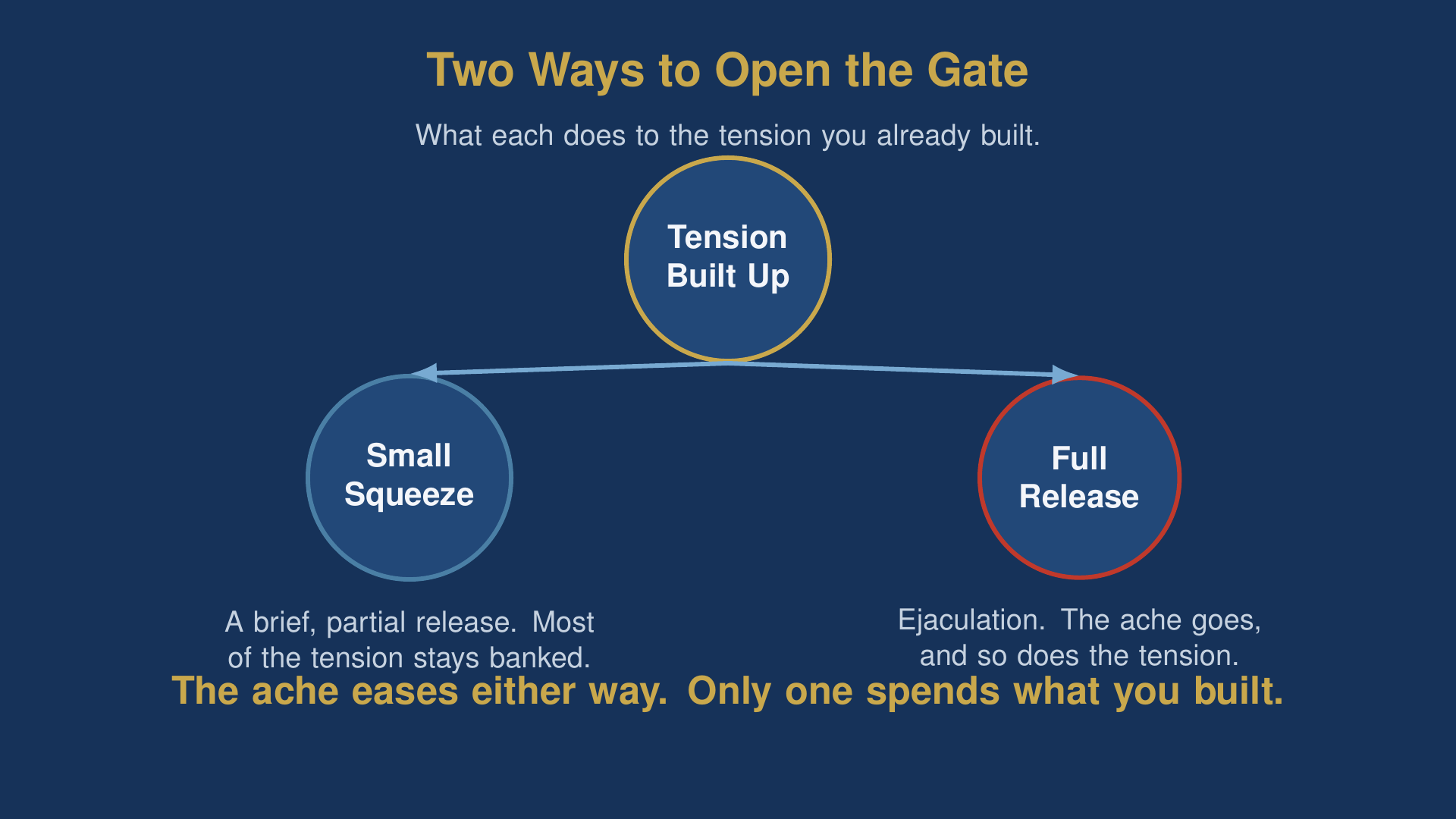
- If it’s still there, open the gate a fraction. Bring yourself back to some stimulation and let a small release happen, a brief squeeze rather than a full finish, so some physical arousal discharges without the whole reservoir of tension going with it. The dam is the picture here: the sexual tension you built is the pressure behind the wall, your PC muscle is the outlet, and opening that outlet a fraction bleeds off pressure while the reservoir stays full. Open it all the way and you empty it.
- If none of that clears it, or you’d rather just be done, finish fully. Ejaculating here spends tension you spent an hour building, and it’s the fallback the book itself lists when the discomfort persists.
Step 3 is mine. The book teaches the small squeeze as a way to build sexual tension mid-session, and its written safety guidance for the ache lists three things: breaks, a cold compress, and ejaculating if the discomfort continues. I’ve moved a technique out of one chapter into a job it wasn’t written for, on the grounds that both jobs run on one lever, how much physical ramp you let through the gate.
The survey behind those numbers asked men in general about approaching orgasm without ejaculating. It never asked men who were extending that window for hours the way this site teaches, so the link between how much you built and how much it aches is mine to defend, and not something anybody has measured.
What I’m Still Testing on Myself
I’ve spent stretches logging my own retention practice night by night, testing full retention against fluid release without orgasm, suppressing the pelvic ramp, timing how long I could hold near the edge. The ache showed up often enough in those logs to become one of the recurring costs, sitting alongside slips and plain fatigue.
On the 10th of February 2024 I ran a heat experiment. I warmed the area with no stimulation to try to draw blood in, meditated, then let arousal build while I went out for the evening. I felt more arousal than usual and the ache arrived partway through. What I wrote down that night was a question I still can’t answer, whether the discomfort blunted how easily I got triggered later on or whether that was a coincidence, and an idea I never went back and tested: warm the area first to draw blood in, then cool it slowly afterwards rather than applying cold right away.
I can’t tell you whether heat-then-cool works, only that I logged the idea and never finished testing it, which is why it sits down here and not in the four steps above.
The Ache Eases and Most of It Stays
The first time you take the ache down with a small release, the difference lands within a minute or two: it eases the way it would after a full finish, and when you check in with yourself afterwards, most of what you built is still sitting there. Your arousal hasn’t reset to zero. You spent a coin out of the reservoir.
That’s worth more of your attention than the relief itself, because you’ve just watched the ache and the tension come apart into two separate things, and you get to choose how much of the second one you give up to fix the first.
This ache builds because arousal has two halves that move at different speeds, and the free emails walk through how those halves interact and where the distance between them comes from.
Managing the ache is the small version of a larger skill: reaching for that same partial release by choice, on a schedule you set, rather than when discomfort forces the issue. Work it in both directions, driving arousal up and then easing it back down, and a session accumulates rather than just running long; open the outlet by fractions and one session builds far more than any single hold ever will. Then there is what all of it is for, the day something sets it off and the whole reservoir arrives at once as physical sensation. I wrote the full thing up in my book: five years of experiments on myself, and the model that came out of them.