Three hours in, you’re not really thinking about anything specific anymore. Time has gone loose. You’re right at the edge, and you’ve been right at the edge for what feels like both ten minutes and all night, and some part of you assumes this has to be about what’s on the screen.
It isn’t. The goon trance comes from something happening in your pelvic floor, and ninety minutes of video is just one slow, unreliable way of triggering it. You can reach the same state on purpose, in a fraction of the time, without a screen anywhere near you.
Search around for gooning and you’ll find two camps arguing over what this is. Kink and lifestyle sites treat it as a scene to get better at: edge longer, watch more, repeat. Recovery sites treat it as a symptom, and the fix is total abstinence. Neither one explains what’s actually happening in your body while it’s happening, because neither one has a mechanism for it.
What’s Actually Happening: Sexual Tension, Not a Kink
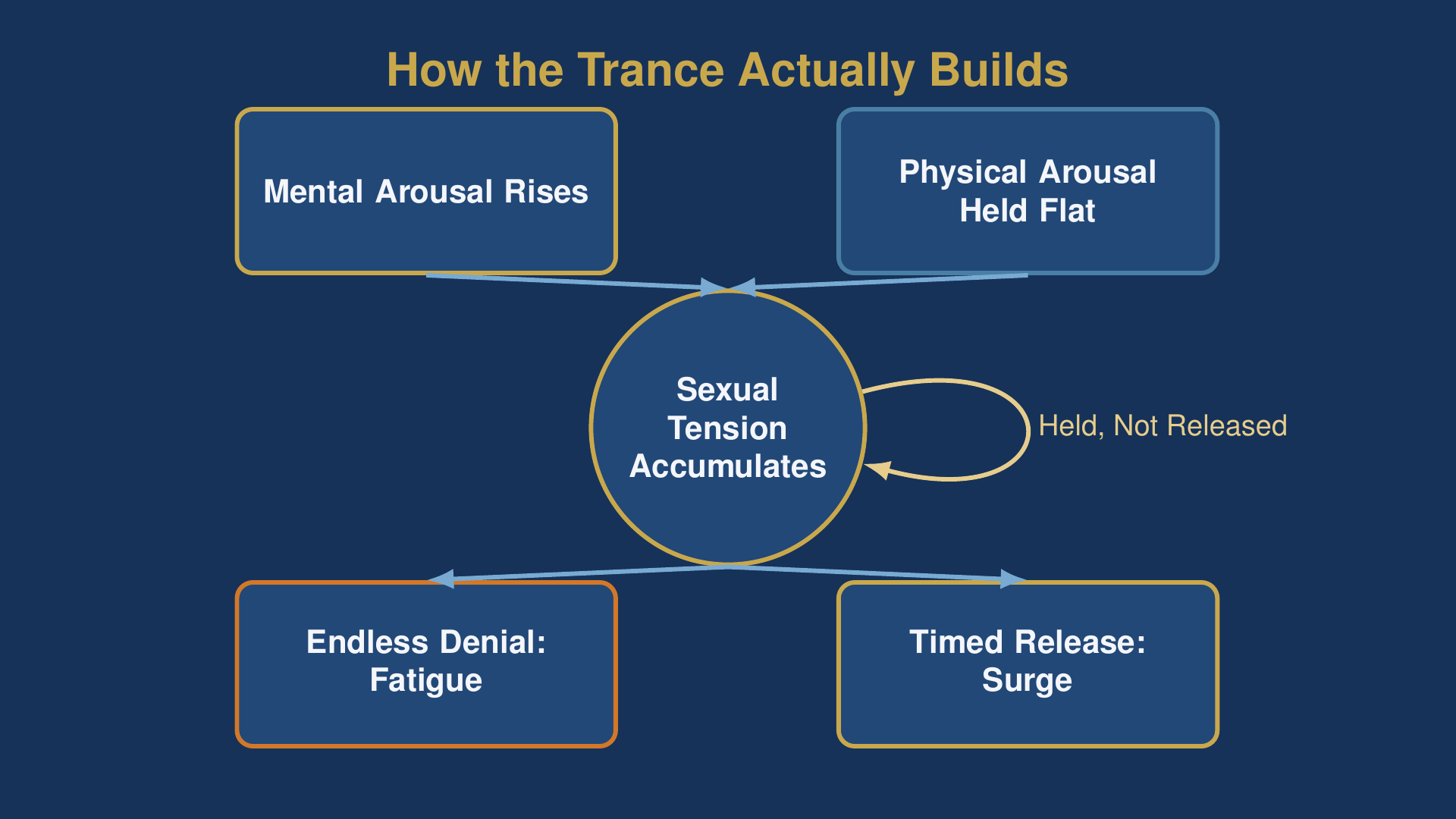
There’s a name for what happens during gooning, and it has nothing to do with porn: sexual tension. Not a synonym for horniness. It’s what accumulates when your mental arousal keeps climbing while your physical arousal is held flat on purpose, instead of being allowed to climb along with it.
Picture a pressure cooker on the stove. Heat is heat, whether it escapes through the safety valve or stays trapped inside, building pressure. Your body runs on the same logic. Rising mental arousal is the heat, and your pelvic floor, specifically the muscle that would normally contract as you approach climax, is the valve. Relax that muscle at the exact moment it wants to contract, and the response has nowhere to go. It doesn’t vanish. It recoils inward. That inward recoil is the trance: mental arousal rising precisely because physical arousal has nowhere left to go.
This is also why the edge never resolves the way your body keeps insisting it’s about to. Ejaculation requires actual physical ramping, not just high mental arousal, so as long as you keep suppressing the physical response, the feeling of imminent climax stays exactly that: a feeling, not an event. Your body reads the growing gap between the two as a sign that release is seconds away and tries to force the issue. It’s an illusion. Once you know it’s an illusion, you can override it instead of chasing it for another hour.
Why Gooning Feels Like a Trance, Not Just Turned On
Sexual tension doesn’t fade the moment stimulation stops. It decays slowly, which is exactly why hours can pass and the state doesn’t break just because your hand does. That slow decay tracks with how the body generally handles prolonged tension: physiological arousal drifts back toward equilibrium slowly rather than snapping back instantly.
During that stretch, while a reward keeps being anticipated but never delivered, dopamine activity in the brain’s reward system stays elevated instead of spiking and dropping the way it would after release, while sustained testosterone keeps desire and drive running in the background. The longer the reward stays unfulfilled, the more sensitive you get to anything even remotely related to it, which is a documented feature of anticipation itself, not something specific to porn or screens.
That’s the actual chemistry behind “time going loose,” and it has nothing to do with the specific video queued up. None of it means anything is wrong with you, either. It’s the same anticipatory circuitry that makes any drawn-out anticipation, sexual or not, feel disproportionately intense the longer it’s held open.
Marathon Porn Is the Slow Route, and Researchers Can See Why
None of this actually requires porn. Porn is just one mental-ramp stimulus for gooning, a way of pushing mental arousal up so there’s something for physical arousal to fall behind. It’s an effective one, which is exactly the problem: effective enough that people default to running it for hours instead of learning to do the suppression itself on purpose.
That default has a documented cost. Researchers studying problematic pornography use have specifically flagged prolonged edging, alongside rising tolerance and a drift toward more extreme material, as patterns that travel together in escalating use. That’s an association drawn from self-reported survey data, not proof that edging by itself causes desensitization. But it lines up with the obvious mechanical problem: if the only way you know how to hold the state is to keep feeding it new material, the amount of material required only moves in one direction.
There’s also a reason passive marathon-watching doesn’t reliably produce the gooning trance even when it never escalates into anything else. Simply abstaining while consuming content raises how attentive you are to sexual cues, which does help mental arousal climb. But mental arousal alone doesn’t accomplish much if physical arousal never gets high enough to have anything to hold back against, and abstinence by itself doesn’t pair that rising mental arousal with the actual muscle-level suppression that redirects it. Without that active piece, watching for longer just means watching for longer. It isn’t the same as running the technique.
The risk was never the trance itself. It’s the specific habit of using hours of escalating content as the only tool for reaching it.
There’s a real physical side to manage regardless of method. Extended arousal without release can cause a mild but genuinely uncomfortable build-up of pressure in the testicles, sometimes called blue balls. Regular breaks help, and so does a cold compress (never ice directly on skin), since cold reliably narrows the local blood vessels and eases the swelling. Use lubrication on longer sessions to avoid irritation, and if you’re going to be at this a while, a wrist wrap saves you the forearm strain. None of that is specific to any one technique. It’s just what extended arousal asks of a body.
The Technique: Building the Gooning Trance With Your Pelvic Floor, Not a Screen
Here’s the actual mechanism, run on purpose instead of stumbled into over three hours of video:
- Warm up. Stimulate normally until you’re solidly, steadily aroused physically, well short of the edge.
- Ramp mentally, hold physically. Increase whatever pushes your mental arousal (fantasy, memory, whatever normally does it) while keeping physical stimulation steady. Push as close to the edge as you can without tipping over.
- Catch the contraction and relax through it. The instant you feel the involuntary pelvic tightening that precedes release, consciously relax that muscle instead of riding the motion. Timing is everything: relax too early and there’s nothing yet to redirect, relax too late and the release has already started.
- Notice the redirect. Done correctly, the sensation that would have discharged outward recoils inward instead. That inward pull, not the video, is the trance.
- Cycle it. Ramp mentally again, catch the next involuntary contraction, relax through it again. Each pass should add to what’s building, not release it.
- Manage the body. Take breaks, use lubricant, apply a cold compress if you need it.
- End it on purpose. Instead of grinding to a stop or pushing through to climax out of habit, pick your moment. Right at the peak, relax your entire body at once, all in a single motion. That one deliberate opening produces a far bigger payoff than either stopping cold or denying yourself indefinitely, because the tension that had nowhere to go finally gets somewhere to go, all at once.
A single full pass, warm-up through the deliberate release, usually runs fifteen to twenty-five minutes once the timing clicks, nowhere near the multi-hour sessions the marathon method depends on.
Two mistakes account for most failed attempts. Relax your entire body instead of just the pelvic floor, and physical arousal drops with it, forcing you back to warm-up. Squeeze instead of relax when you feel the contraction coming, and you’ll physically ramp straight through it. The muscle you’re working with is specific, and the direction is always the same: hold everything else exactly where it is, and let go of just that one point.
Most people need three or four cycles before the redirect becomes obvious. Fewer than that, and physical arousal probably crept up anyway. Ease off, drop back down a notch, and try the contraction again from there. The skill is in the timing, not in finding the right content.
Once you’ve felt that redirect a few times, you’ll recognize it fast, in bed, in the shower, wherever, without needing three hours of gooning or a queue of anything loaded up first. The trance was never the reward for outlasting a screen. It’s a switch, and now you know where it is.
If you know someone who’s been chasing gooning through longer and longer sessions, quietly wondering whether that’s just how it works or whether something’s off, send them this. The technique above is complete as it stands: warm up, ramp, catch the contraction, relax through it, cycle, release on purpose. Nobody needs to buy or sign up for anything to run it tonight.
If it clicked for you the way it’s supposed to, this isn’t the only mechanism like it in the book’s framework, and new ones like this go out by email before they ever become an article.
What’s above gets you one session, deliberately, on command, whenever you decide to run it. The book is where the rest of the system lives: stacking gooning sessions across an entire day instead of one sitting, a second workflow for compounding tension instead of just cycling it, and the full safety protocol for sustaining sessions like that over time.