I first ran into the phrase “PC muscle exercise” in one of two contexts: as a fix for erectile dysfunction, or as a way to last longer in bed. Both framings point at the same muscle, and both stop one step short of the more interesting thing about it.
The PC muscle is not primarily a muscle to strengthen. It is a valve. And in the context of deliberate sexual practice, learning to relax it on command is a more important, more neglected skill than any kegel routine on its own will give you.
This article covers what the PC muscle actually does during arousal, how to locate it precisely, what a standard PC muscle exercise trains, and what the reverse kegel trains instead. By the end you will have a starting version of each, the common ways men get both wrong, and a clearer picture of why the distinction matters more than the exercise itself.
What a PC Muscle Exercise Is Actually Training
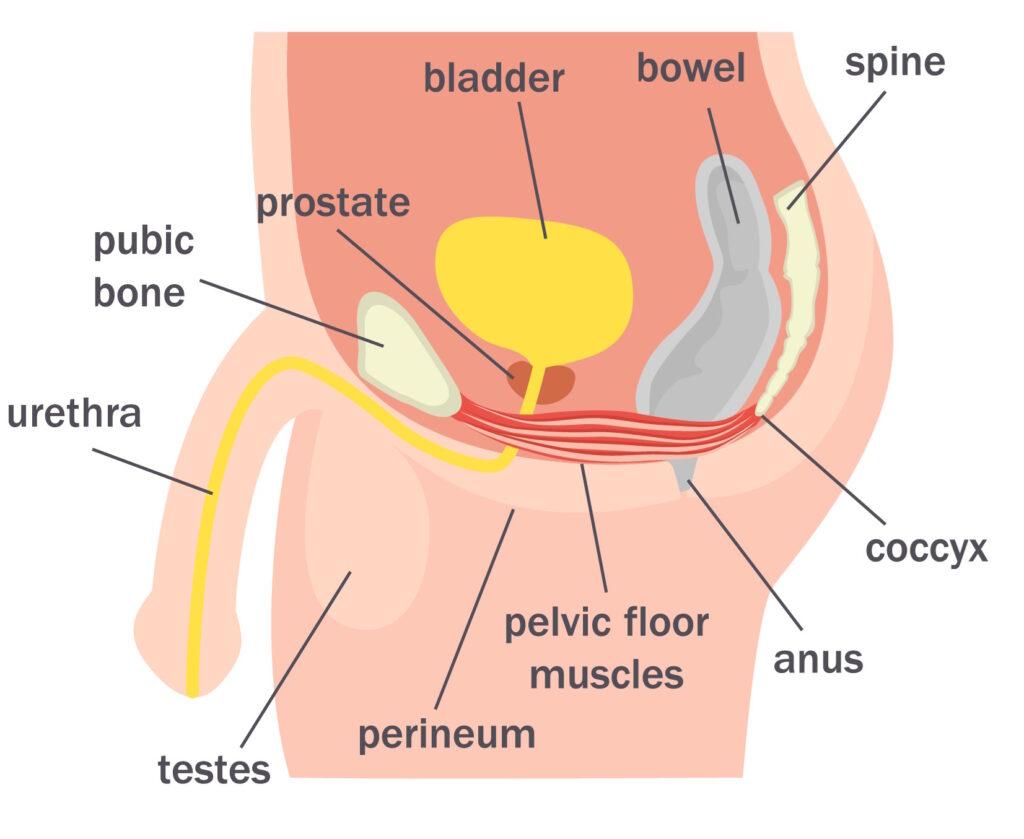
The pubococcygeus muscle, or PC muscle for short, forms a sling across your pelvic floor, running from the pubic bone at the front to the tailbone at the back. You have been using it your entire life without necessarily knowing its name. It is the muscle you contract when you stop the flow of urine mid-stream. It is also the muscle that contracts rhythmically during ejaculation to propel semen through the urethra.
That second function is the one that matters most for this article.
As physical arousal climbs toward the point of no return, the PC muscle begins to engage involuntarily. The twitching and pelvic pulses you feel as you approach climax are largely the PC muscle firing. By the time ejaculation occurs, it has taken over completely.
Research on the human sexual response cycle has confirmed what the Taoists observed centuries earlier: the pelvic floor is both a signal and a driver of climax. When it contracts, arousal rises. When it fires fully, ejaculation follows.
What almost nobody teaches in a typical PC muscle exercise routine is the other direction: what happens when you deliberately relax it instead of squeezing it harder.
Kegels: What They Train and What They Don’t
This is the version of the PC muscle exercise most men have already tried by the time they land on this page. A kegel exercise is simply a contraction of the PC muscle held for a few seconds and then released. Named after physician Arnold Kegel, who developed the technique in the 1940s to treat urinary incontinence, it has since become the default PC muscle exercise recommended to men for erection quality and pelvic floor strength. The research supporting this is real. In a randomized controlled trial published in BJU International, Dorey and colleagues found that pelvic floor muscle exercises significantly improved erectile function in men with vasculogenic erectile dysfunction.
Kegels build strength and awareness. Both are useful starting points. Strength means the muscle can contract more forcefully. Awareness means you can feel it engaging and disengaging, which is the prerequisite for everything that comes after.
The limitation of a standard PC muscle exercise like this is that it only trains half of the muscle’s range of motion: the contraction half. It makes you better at squeezing. It does not train you to relax the muscle on demand, which is the skill deliberate sexual tension practice actually requires.
How to Do a Basic Kegel
Locate your PC muscle using the urine-stop method. Next time you urinate, stop the flow mid-stream. That contraction is the target muscle. Once you’ve identified it, practice without urination.
Contract the PC muscle as if stopping urine flow. Keep the contraction isolated, avoiding your abdomen, buttocks, or thighs. Hold for five seconds, then release fully and return to neutral. That’s one repetition.
Progress by adding repetitions, extending the hold time, or increasing the intensity of the contraction. The key throughout is isolation: the PC muscle should be doing the work, not the muscles around it. This basic PC muscle exercise takes under a minute a day to start, which is exactly why so few men ever move past it to the half that’s harder to isolate.
The Reverse Kegel: The Half of the PC Muscle Exercise Most Men Skip
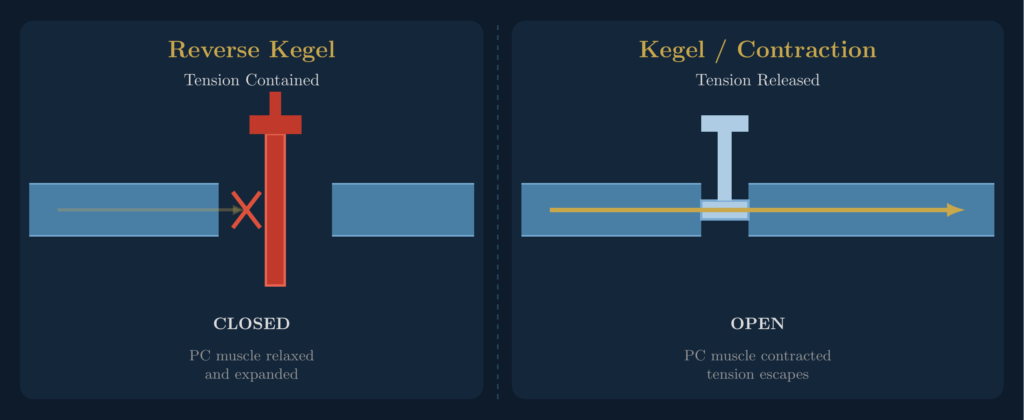
If a kegel is a contraction, a reverse kegel is a deliberate expansion. It is the opposite motion: the feeling of allowing urine to flow rather than stopping it, or of gently encouraging it to flow faster. You can also recognize the motion during defecation, though the target for practice is a subtler, more controlled version of that release.
Most men have never intentionally performed this motion outside of a bathroom. That is the gap a PC muscle exercise built only around kegels leaves open, and it’s why most guides on the subject never get past the squeeze.
The reverse kegel matters for one specific reason: it is the mechanism by which the PC muscle releases its grip at the moment it most wants to contract. When arousal is high and the body is pushing toward ejaculation, the instinctive response is for the pelvic floor to tighten. A man who has trained the reverse kegel can override that response. Not by brute force suppression, but by consciously expanding the muscle at the moment it wants to fire.
When timed correctly, this has a specific effect: the physical ramp response is suppressed. The body doesn’t release. The tension that would have escaped stays contained. This is the mechanism behind sexual tension accumulation, and the PC muscle is the primary valve controlling it.
That override is the same skill used at a much finer threshold in more advanced ejaculation control exercises, where the suppression has to land at the exact moment the ejaculatory reflex is about to fire, rather than anywhere in the general vicinity of high arousal.
How to Do a Reverse Kegel
The reverse kegel is harder to isolate than a regular kegel because the sensation is subtler and the motion is less familiar. Start by observing it naturally: next time you urinate, pay attention to the expansion that occurs as you allow the flow to begin. That relaxation and gentle encouragement of flow is the motion you are training.
To practice in isolation, gently relax the PC muscle and imagine allowing urine to flow, then gently encouraging it to speed up. Keep the motion isolated to the pelvic floor and avoid bearing down with your abdomen or engaging your buttocks. Hold the expansion for five seconds. Return to neutral.
The most common mistake is confusing a reverse kegel with simply doing nothing. Neutral is not the same as expansion. A reverse kegel is an active release, not an absence of contraction. With practice, the difference becomes clear.
Where Men Go Wrong With Kegels and Reverse Kegels
A few mistakes come up often enough in PC muscle exercise practice to name directly.
The first is treating the reverse kegel as identical to doing nothing. Neutral is a resting state; a reverse kegel is an active release, a deliberate widening rather than an absence of squeeze. If you can’t tell the difference at rest, you won’t find it under arousal, which is the only place it actually matters.
The second is recruiting the wrong muscles during either half of the exercise. The abdomen, buttocks, and thighs are quick to volunteer, especially as intensity rises, and they’ll happily do the PC muscle’s job if you let them. A PC muscle exercise that engages the whole pelvic region isn’t training the specific muscle you need control over. It’s training general tension, which works against the goal.
The third is only ever training the contraction. Most kegel instructions, whether aimed at incontinence or erectile function, stop there, and a PC muscle exercise that stops there is exactly what leaves men able to squeeze but unable to release on command at the one moment release is what the body least wants to do.
The fourth is expecting the reverse kegel to feel natural quickly. It won’t, at first. The muscle has spent a lifetime being trained in one direction only. Judge progress by whether the release is getting easier to locate under low arousal, not by whether it feels effortless yet.
Why the Right PC Muscle Exercise Prioritizes Control Over Strength
There’s a reason this piece keeps circling back to control rather than strength. Any PC muscle exercise, done consistently, will make the muscle stronger, and that carries genuine health benefits regardless of what you do with the rest of this framework. But for the practice of building sexual tension deliberately, a strong PC muscle you cannot consciously relax is less useful than a moderately strong one you can release on command.
The sequence that matters is this: arousal rises, the body initiates a physical response that includes pelvic contraction, and you choose, in that exact moment, to expand rather than contract. If your only trained direction is contraction, that choice doesn’t exist for you. You’ll feel the contraction happening. You won’t have the motor control to reverse it.
Training both directions gives you the full range the practice requires: kegels for awareness and strength, reverse kegels for the deliberate release. A PC muscle exercise that only trains one direction is half a skill. Neither half is optional if the goal is control rather than just a firmer squeeze.
This is one piece of a larger framework, not the whole of it. The PC muscle is the primary valve, but the practice also involves how physical and mental arousal interact, how sexual tension builds over time, and what to do with it once it has. In the model this book builds, sexual tension is the gap between how mentally aroused you are and how physically aroused you are, formally T = M − P. Every time you relax the PC muscle instead of letting it fire, you’re protecting that gap instead of collapsing it.
Where to Go From Here
A PC muscle exercise on its own, kegel or reverse kegel, is just motor control in isolation. If you want to see how relaxing the PC muscle at the right moment actually produces sexual tension, and what that tension leads to when it’s sustained rather than released, the edging technique is where that mechanism gets covered directly. Reverse kegels are the physical half of it; edging is the practice that puts them to use.
If the T = M − P idea is new to you and you want the complete four-variable model before going further, that’s exactly what the free framework PDF covers: a one-page analytical summary of S, P, M, T, and the single relationship connecting them, written for a reader who wants the mechanism stated precisely rather than gestured at.
If you already want the full practice, meaning the specific exercises, their progressions, and the workflows that turn this control skill into a repeatable session, the book is where it lives.
Comments
5 responses to “PC Muscle Exercise: Why Relaxation Matters More Than Strength”
[…] specific skill is sometimes called a reverse kegel: deliberately relaxing and expanding the PC muscle at the moment it wants to clench, rather than […]
[…] at the PC muscle and its central role in the climax reflex. I go into that muscle in detail in PC Muscle Exercise: Why Relaxation Matters More Than Strength; the short version is that Chia identified the right muscle. And the withholding principle at the […]
[…] PC muscle is the primary driver of that cascade. It engages involuntarily as arousal rises, and its full […]
[…] on demand: they have accumulated fuel without a map of the ignition mechanism. Learning to work the PC muscle deliberately, relaxing it at the exact moment it wants to fire instead of only strengthening it, is […]
[…] arousal continues climbing toward release or gets deliberately held. I cover this in detail in the PC muscle and reverse kegel article, but the short version is that relaxing this muscle at the moment it wants to contract is what […]