I spent years treating ejaculation control as damage control. Slow down. Think about something else. Grit through the last thirty seconds and hope the timing works out. It worked often enough to keep me doing it, and it taught me nothing, which meant every attempt started from zero.
That is the trap most ejaculation control exercises fall into, and it is worth naming honestly before I explain the alternative. Distraction genuinely works: pulling mental attention away from the body reduces mental arousal, and mental arousal drives physical arousal through the same mind-body connection that governs every stage of the response. The stop-start method genuinely works too: reducing stimulation before the point of no return gives the body time to settle. Kegel exercises build real strength and real awareness in a muscle most men have never consciously engaged. None of this is wrong. All of it stops one step short of the mechanism. Once you understand that mechanism, these same ejaculation control exercises stop being a grab-bag of tricks you deploy under pressure and start being a coherent skill you build on purpose, session after session.

What Most Ejaculation Control Exercises Get Wrong
The problem with distraction and stop-start is that they manage the outcome without addressing the process. Both treat ejaculation control as a timing problem: reduce arousal, delay the moment, repeat as needed. Neither teaches you what is actually happening in your body in the seconds before control is lost, which means neither gives you anything to build on session over session. That is precisely the gap that mechanism-first ejaculation control exercises are built to close: not a better version of stopping in time, but an actual explanation of what your body is doing and why.
Here is the reframe I want to make explicit, because it is the difference between exercises that plateau and exercises that compound: ejaculation control is not a feat of willpower, and it is not the suppression of a malfunction. It is precise motor control over a single involuntary reflex, developed by learning to recognize an approaching threshold and intercept the muscular cascade that carries you toward it. That is a trainable skill in the same sense that any other fine motor skill is trainable. It is not a mental trick.
The Mechanism Behind Ejaculation Control Exercises: A Threshold, Not a Wall
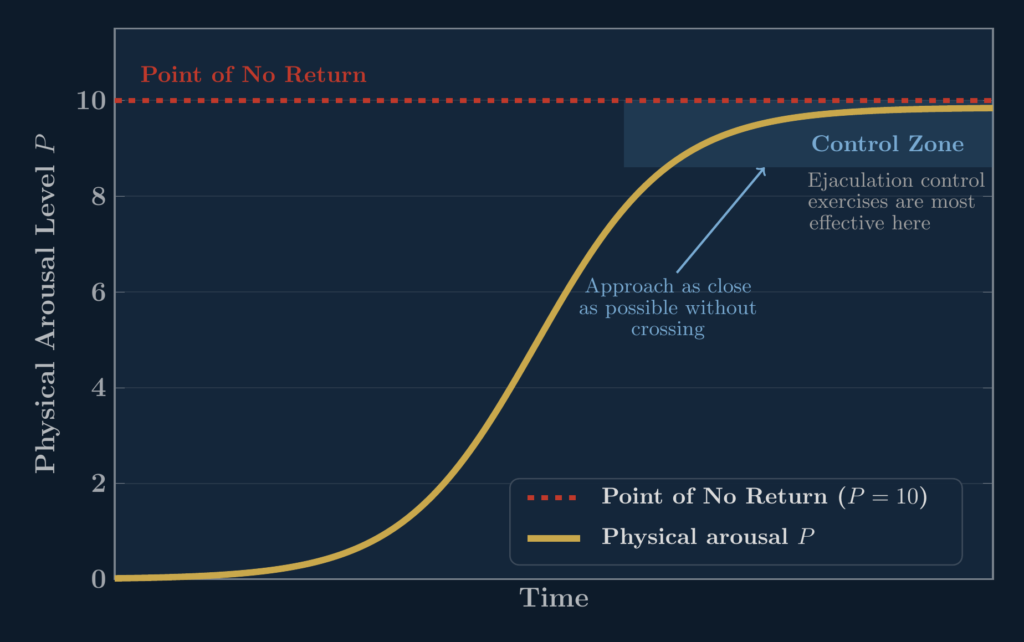
Physical arousal progresses through recognizable stages before you reach that threshold. The Taoist tradition documented five of them centuries before Western sexology caught up: lengthening, swelling, hardness, heat, and the point of no return. Mapped to a numerical scale, physical arousal level P runs from 0 to 10, where P equals 10 is the point of no return: the moment the ejaculatory reflex fires and ejaculation becomes inevitable even if all stimulation stops.
The insight that makes ejaculation control exercises trainable, rather than a matter of luck, is that the point of no return is a threshold, not a wall. With deliberate practice, you can learn to approach P equals 9.1, then 9.2, then 9.3, getting closer to the edge with increasing precision instead of lunging toward it blind. That precision is itself the skill these exercises are built to develop.
What decides whether you cross the threshold at a given level is the physical ramp response: a cascade of involuntary events that fires as arousal climbs, including muscle tension through the thighs and buttocks, pelvic floor contraction, interrupted breathing, and a rising heart rate. These are not just symptoms that ejaculation is close. They are the mechanism by which arousal accelerates toward the threshold once it starts, each response pushing physical arousal higher than the last.
The PC muscle is the primary driver of that cascade. It engages involuntarily as arousal rises, and its full contractile sequence during ejaculation is what propels semen through the urethra. Learning to manage what that muscle does in the seconds before the threshold is, at the most precise level, what ejaculation control exercises are training you to do.
The clinical literature backs this up more directly than most men expect. In a study of forty men with lifelong difficulty controlling ejaculation, twelve weeks of structured pelvic floor training brought the large majority of them to measurable control of the ejaculatory reflex, with most of the gains holding at six-month follow-up. Control of this reflex is not a fixed trait. It is a muscle skill, and muscle skills respond to structured practice.
Ejaculation Control Exercises: Building Awareness Before Control
The exercises below build in sequence. Awareness has to come before control, because you cannot manage what you have never learned to observe with precision, and most men have never been taught to observe their own arousal beyond “not yet” and “too late.” Each of these three ejaculation control exercises depends on the one before it, so resist the urge to skip ahead to the last one.
Exercise 1: Mapping Your Physical Levels
The first of these ejaculation control exercises has one job: build a reliable internal map of your own stages before you attempt any control at all.
Begin stimulation from a resting state and progress slowly, pausing at each stage to notice what is actually happening in your body. At the swelling stage, notice the muscle engagement beginning in your thighs and lower abdomen. At the hardness stage, notice the pelvic floor becoming more active and your breathing starting to deepen. At the heat stage, P equals 9, notice how the body wants to accelerate on its own. That pull is the ramp response beginning in earnest.
You are done with this exercise when you can name each stage by feel alone, without stopping to think about it. Most men need several sessions to get there. That precision is the prerequisite for everything else in this article, so do not rush it. Skipping this stage is the single most common reason ejaculation control exercises fail to produce results.
Exercise 2: Approaching the Threshold Deliberately
Once your internal map is reliable, the second exercise is to approach the threshold on purpose instead of stumbling into it.
Bring yourself to the heat stage and hold there, not by withdrawing stimulation entirely but by reducing it just enough to stay below the threshold while staying as close to it as you can tolerate. The goal is not to avoid the edge. It is to become comfortable occupying it. Most men retreat the instant they hit P equals 9 because the urge to cross feels stronger than the will to stay, and this exercise exists specifically to train the capacity to stay.
Keep your attention on the PC muscle throughout. At the heat stage it will want to contract on its own. Do not help it. Let it stay as relaxed as you can manage, even while everything else in your body is pulling toward the threshold. This is the reverse kegel applied live, under real arousal, rather than practiced in isolation. Of the three ejaculation control exercises in this sequence, this is the one most men find hardest, because staying near the edge on purpose runs against every instinct built by years of retreating from it.
Exercise 3: The Suppression Moment
This is the core ejaculation control exercise, and it targets the exact moment the physical ramp response initiates.
As you hold at the heat stage, you will feel the body start to accelerate: the PC muscle engaging, the thighs tightening, breathing becoming interrupted. At that precise moment, instead of withdrawing stimulation the way the stop-start method teaches, perform a deliberate reverse kegel: actively expand and relax the PC muscle rather than letting it contract.
Timed correctly, this interrupts the ramp response outright. Physical arousal does not accelerate past the threshold. The sensation that would have escaped stays contained instead. With repetition, this moment becomes something you can recognize with increasing precision, until you can meet the ramp response the instant it starts rather than a half-second after.
This is the mechanism underneath what the stop-start method only gestures at. Stopping stimulation works because it gives the PC muscle time to relax on its own. This exercise trains you to relax it actively, on demand, without needing to stop at all.
What These Ejaculation Control Exercises Build Toward
Practiced consistently, these three ejaculation control exercises develop two things at once: a precise map of your own arousal and the motor control to manage the PC muscle’s response at the exact moment it matters. Neither is the end goal. Both are the foundation for something larger.
In the framework I use, sexual tension is defined formally as T = M − P: the gap between mental arousal and physical arousal. When you can hold physical arousal below the threshold while mental arousal keeps climbing, that gap is what widens. The edging technique is the practice built specifically to widen it on purpose, and everything you develop through these ejaculation control exercises is what makes that practice possible in the first place. Without the ability to hold below the threshold with precision, there is no gap to build. With it, the gap becomes something you can accumulate deliberately rather than something you stumble into by accident.
Where to Go From Here
If the S/P/M/T model is new to you, the free framework PDF is the right place to start. It lays out all four variables and the single equation that connects them, including exactly where ejaculation control exercises fit inside the larger system, before any of the practice begins.
If you already have the model and want the complete practice, meaning the two workflows for turning this control into a full session and the recovery protocol that keeps you from blunting your own progress through overuse, that is what the book covers in full.
Comments
One response to “Ejaculation Control Exercises: 3 Proven Techniques and the Mechanism Behind Them”
[…] override is the same skill used at a much finer threshold in more advanced ejaculation control exercises, where the suppression has to land at the exact moment the ejaculatory reflex is about to fire, […]