I came to karezza the same way I come to most things: analytically, with a notebook, and with the specific question of what it actually does to the body rather than what its practitioners believe it does. The premise was immediately interesting. Here was a practice built on a single claim: that withholding orgasm during intimacy produces a fundamentally different experience, and that the difference is real and reproducible enough to build an entire method around.
That claim is correct. What karezza leaves out is the mechanism. And the mechanism matters enormously — because without it, the practice is inconsistent, frustrating to troubleshoot, and impossible to build on deliberately.

What karezza gets right about withholding
Karezza, developed in the late nineteenth century by the American physician Alice Bunker Stockham, is a practice of intimate physical contact, including intercourse, without the goal of orgasm. The karezza method involves sustained, slow, deliberate physical connection. Release is withheld. The experience, practitioners consistently report, is qualitatively different from ordinary sex: more expansive, more present, accompanied by a sense of heightened aliveness that persists after the encounter ends.
These reports are consistent across a wide enough range of sources that they deserve a physiological explanation rather than dismissal. Stockham herself observed that couples who practiced it reported a deepened sense of connection and vitality that distinguished it from ordinary sexual experience. Later writers on the karezza method, including John William Lloyd in his 1931 work on what he called magnetation, documented similar observations. The tradition has existed for over a century because the phenomenon it points at is real.
The explanation for what is happening is straightforward once you have a framework for it.
When orgasm is withheld during this kind of sustained intimacy, the body’s default arousal-and-release cycle is interrupted. Stimulation continues. Mental arousal rises. Physical arousal rises. But the habitual endpoint, ejaculation and the release of accumulated tension, does not occur. Something builds instead. The longer the withholding is sustained, the more of it accumulates.
I call this quantity sexual tension: the widening gap between mental arousal, which keeps climbing, and physical arousal, which stops catching up to its usual release point. Under ordinary conditions this gap stays near zero, because physical arousal reliably catches up to and then releases mental arousal through ejaculation. Karezza interrupts that cycle and allows the gap to widen. The result is a sustained internal state that the tradition describes in terms of energy, presence, and connection, but which is more precisely described as accumulated sexual tension that has not been discharged.
Karezza is right that withholding changes something real. It is right that the change persists beyond the encounter. It is right that this state is qualitatively different from what ordinary sex produces. On all of these points, the observation is sound.
Where karezza’s explanation falls short
The limitation of the practice as a framework is not in its observations but in what it offers as an explanation and as instruction.
The tradition typically attributes the effects of withholding to energy: specifically, the conservation and redistribution of sexual energy that would otherwise be lost through orgasm. This language is evocative and has a long history across traditions, from Taoist sexual practice to tantra to the nineteenth-century American spiritualist currents from which this practice emerged. But it is not precise enough to act on. A man who wants to practice karezza consistently cannot measure his energy level, cannot tell whether he is doing it correctly, and cannot diagnose why a session that should have worked did not produce the expected result.
The second limitation is that karezza frames withholding as the goal itself. The sustained state of non-climactic intimacy is, in the tradition’s own terms, the endpoint. The karezza meaning is, in essence, “the state you maintain.” The point is to remain in that state, to share it with a partner, to let it deepen the connection between you.
This framing leaves out something important: what happens when that accumulated tension meets the right trigger.
In the framework I have developed through years of systematic self-experimentation, withholding is not the endpoint. It is fuel-building. The accumulated sexual tension that karezza correctly identifies and values is not complete in itself. It is a reservoir. When a triggering event, the right stimulus at the right moment of sufficiently accumulated tension, releases that reservoir, what follows is something the tradition has no name for: a sudden, overwhelming whole-body surge that I call Sexual Awakening. Orgasm and ejaculation are two separate physiological events, and Sexual Awakening occupies the space between them.
Karezza practitioners who report moments of unexpected intensity during sustained intimacy have stumbled into this. But the tradition gives them no map for why it happened, how to reproduce it, or how to approach it deliberately. That map is what the Arousal State framework provides.
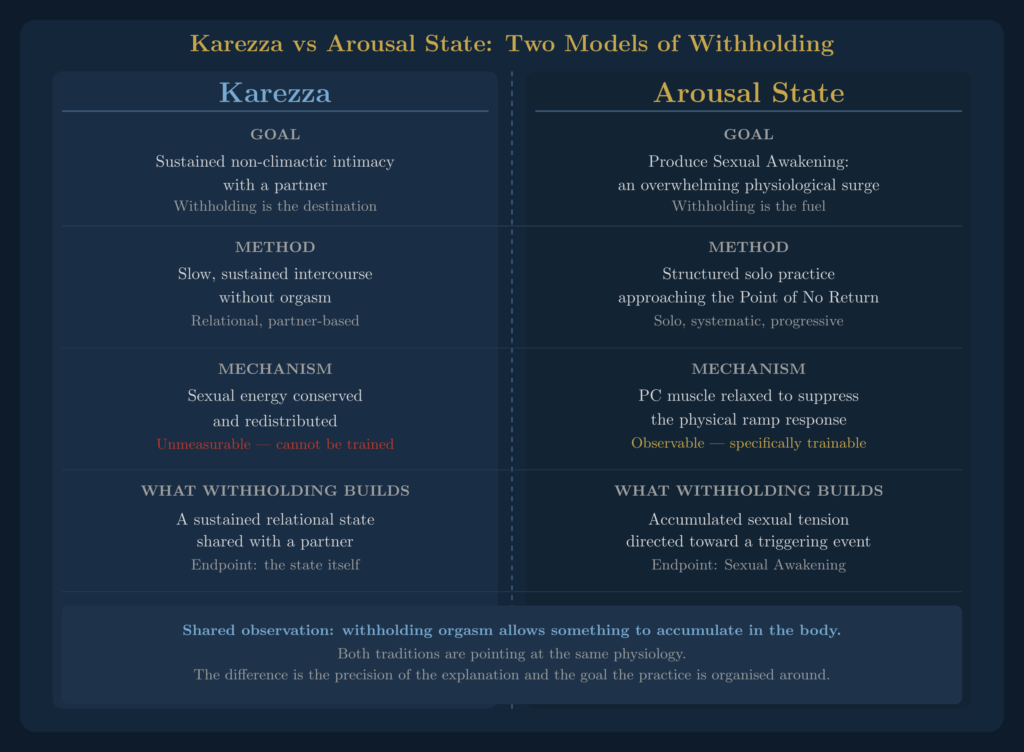
The mechanism karezza is missing
The precise mechanism underneath the method’s effects comes down to one muscle and one trainable skill.
As physical arousal rises during intimacy, the body initiates what I call the physical ramp response: a cascade of involuntary events including engagement of the PC muscle (the pubococcygeus, running from the pubic bone to the tailbone), tension in the thighs and buttocks, interrupted breathing, and increased heart rate. Each of these responses drives physical arousal higher toward the Point of No Return, the threshold at which ejaculation becomes inevitable regardless of what happens next.
The PC muscle is the primary valve in this process. When it contracts involuntarily, it moves physical arousal toward ejaculation. When it is deliberately relaxed in the window when the ramp response wants to initiate, the cascade is interrupted. Physical arousal stays below the threshold. Sexual tension continues to accumulate rather than discharge.
This is the specific physical skill that makes withholding consistent and trainable rather than a matter of willpower or luck. Karezza practitioners who successfully maintain the practice are, whether they know it or not, performing a version of this suppression. The ones who struggle, who find the karezza technique difficult to sustain or inconsistent in its effects, typically lack the precise body awareness needed to sense when the ramp response is beginning and meet it before it completes.
Understanding the mechanism changes what the practice requires. It is not about maintaining a certain mental attitude or a quality of presence, though both are genuinely useful. It is a physical skill that can be trained systematically, with clear feedback and clear progressions. The edging article on this site covers how to develop that awareness and train the suppression skill starting from scratch.
The triggering event: what karezza doesn’t account for
There is a further dimension the tradition does not address, and it is the one that matters most for what the Arousal State framework is actually trying to produce.
Karezza positions the sustained intimate state as the reward itself. The absence of orgasm is not a deprivation but the practice. The accumulated tension is something to rest in, to share, to allow to deepen the relational bond.
The Arousal State framework takes a different view: the accumulated tension is not the destination. It is the fuel that makes a specific downstream experience possible. When that accumulated tension is released by the right triggering event at the right moment, what results is a physiological event of a completely different order of magnitude from anything a session, however long or well-practiced, produces in isolation.
This is not a criticism of the method as a relational practice. For the purpose it is designed for — sustained, non-climactic intimacy that deepens partner connection — it is coherent and honest about its goals. But a man who has practiced this method and noticed moments of unexpected intensity at certain points in a session, and who wants to understand what produced those moments and how to reach them deliberately, will not find the answer inside the tradition. The tradition has no name for the phenomenon and no systematic method for approaching it on purpose.
The Arousal State framework is that method.
Karezza and the Arousal State framework: what connects them
Karezza and the Arousal State framework are not competing methods. They address different contexts and have different explicit goals.
Karezza is a relational practice, built around sustained intimacy with a partner. Its emphasis on presence, slowness, and connection is part of the method, not incidental to it. The tradition has value on its own terms and the century-long consistency of practitioner reports is evidence that it is pointing at something real.
The Arousal State framework is primarily a solo practice, built around deliberate self-experimentation. Its emphasis is on understanding the physiological mechanism precisely enough to reproduce specific states on demand, and then to take those states into real-world encounters where a triggering event can release them.
What they share is the underlying observation: withholding allows something to accumulate, and that accumulated state is genuinely different from and more interesting than the default arousal-and-release cycle most men experience. Both traditions are pointing at the same physiology. The difference is the precision of the explanation, the completeness of the instruction, and the ultimate goal the practice is organized around.
If you practice it and find it compelling but inconsistent, the missing piece is almost certainly the body awareness and physical skill described in the mechanism section above. If you have never tried it but are drawn to the question of what sustained withholding does to the male body, the Arousal State framework offers a more systematic starting point, because it gives you both the mechanism and a reproducible method for building toward a specific outcome.
Where to go from here
Karezza points at something real. The physiological observation at its core, that withholding changes the internal state in a measurable, persistent way, is correct. What the tradition lacks is the precise mechanism behind the effect, the name and explanation for what that accumulated tension can become when it meets the right triggering event, and the systematic method for approaching that outcome deliberately.
Those three elements are what the Arousal State framework provides. The complete system, including how to build sexual tension deliberately, how to identify and use a triggering event, and how to produce Sexual Awakening as a reproducible experience, is laid out in full in the book. The Taoist sexuality article on this site covers similar territory for readers who arrived through that tradition.
If this reframe is new to you, a free framework PDF is the right next step. It lays out the four-variable model, S, P, M, T, cleanly and provides the theoretical foundations needed for Arousal State.
If you are ready for the complete system, how to structure a session for maximum intensity, how to manage rest and recovery between gooning or edging sessions, and how to actually direct accumulated tension toward a real-world trigger, the book covers all of it in full.