You slow down. You hold eye contact. You stay still instead of thrusting, exactly like every karezza guide says. For the first ten minutes it works. Then the tension you built just quietly leaks out, your arousal dips, and you’re back to doing the same slow motions with nothing happening. No guide tells you why.
The Missing Piece in Karezza: What You Do With Your Pelvic Floor
Karezza itself is old. Alice Stockham’s 1896 Karezza, Ethics of Marriage coined the term, from the Italian word for caress, building on a slower, deliberately non-orgasmic style of intercourse first practiced decades earlier by the Oneida community. The appeal hasn’t changed since. It feels different from ordinary sex: closer, less performative, and part of that is genuinely explainable. Slow, unhurried intimacy taps the same oxytocin pathways linked to perceived partner responsiveness and felt gratitude in long-term couples.
The standard instructions for getting there are consistent across nearly every source that covers karezza: relax, keep touch unhurried, hold eye contact, stay still or nearly still during penetration, and give it a few weeks before expecting much.

Four of those five instructions are doing real, specific work, even though no guide says so directly. Staying still during penetration avoids the friction that would otherwise trigger a release. Unhurried touch and eye contact keep mental arousal climbing without a matching spike in physical arousal, which is the exact mechanism that produces sexual tension in the first place.
Picture a pressure cooker on the stove. Raising the heat is like raising either kind of arousal: some of that energy escapes as pressure building inside the pot, and some escapes as steam through the valve. Relaxing at the right moment is what keeps the energy inside as pressure instead of bleeding it out through the valve early. That’s what unhurried touch and eye contact are actually doing this whole time: feeding the heat without cracking the valve open too soon.
And “give it a few weeks” is really an instruction to get better at noticing your own arousal before it happens instead of after.
What’s missing is the fifth thing: what to actually do with your pelvic floor once arousal starts climbing toward that edge. Every karezza guide tells you to relax. None of them say what happens to that instruction once your body is thirty seconds from involuntarily contracting anyway, which is exactly the point where most sessions quietly fall apart.
Four of karezza’s five standard instructions are already doing real physiological work. The fifth, what to do with your pelvic floor once arousal climbs, is the one nobody names.
The Relaxation Dilemma: Why More Relaxing Backfires
This is the point where “just relax more” stops working, and there’s a specific physiological reason for that. Building sexual tension requires suppressing the physical ramp response, the pelvic contraction your body wants to make once mental arousal rises. The deeper you relax to suppress it, the more that relaxation bleeds into the rest of your body. And because physical arousal and mental arousal are tightly coupled (what the book that maps this mechanism, Arousal State, calls the mind-body connection), a physical dip drags mental arousal down with it. You don’t just lose ground on one side. You lose it on both at once.
That’s why “stay relaxed and keep building” is a harder instruction to follow than it sounds. It’s easy to throw two balls up and catch them, or throw both down and catch them. Try to throw one up and one down at the same time, and the task gets exponentially harder: the nervous system struggles to run opposing motor patterns simultaneously, a conflict documented in motor-control research as bimanual interference.
Staying relaxed enough to build tension while staying aroused enough to sustain it is functionally the same conflict, played out in one body instead of two hands. That’s not a failure of discipline. It’s a coordination problem, and trying harder to relax doesn’t resolve it, because relaxing harder is the thing causing the dip.
There’s a reason it’s worth pushing through the dilemma instead of giving up at the first dip. Sexual tension behaves like potential energy: jump on a trampoline without pressing down first and you barely leave the ground, but the deeper you press before letting go, the higher the rebound. Every bit of tension you manage to hold onto through a dip is stored energy for the release that eventually comes, which is exactly why the fix below isn’t about avoiding the dip altogether. It’s about controlling how much you give up when it happens.
The plateau isn’t you doing karezza wrong. It’s what happens when relaxation gets treated as a single all-or-nothing switch instead of something you can apply in degrees.
The Karezza Fix: Treat the Pelvic Floor as a Dial, Not a Switch
The instruction missing from every karezza guide isn’t “relax less” or “relax more.” It’s to stop treating your pelvic floor as binary, fully open or fully closed, and start using it the way you’d use a dimmer instead of a light switch.
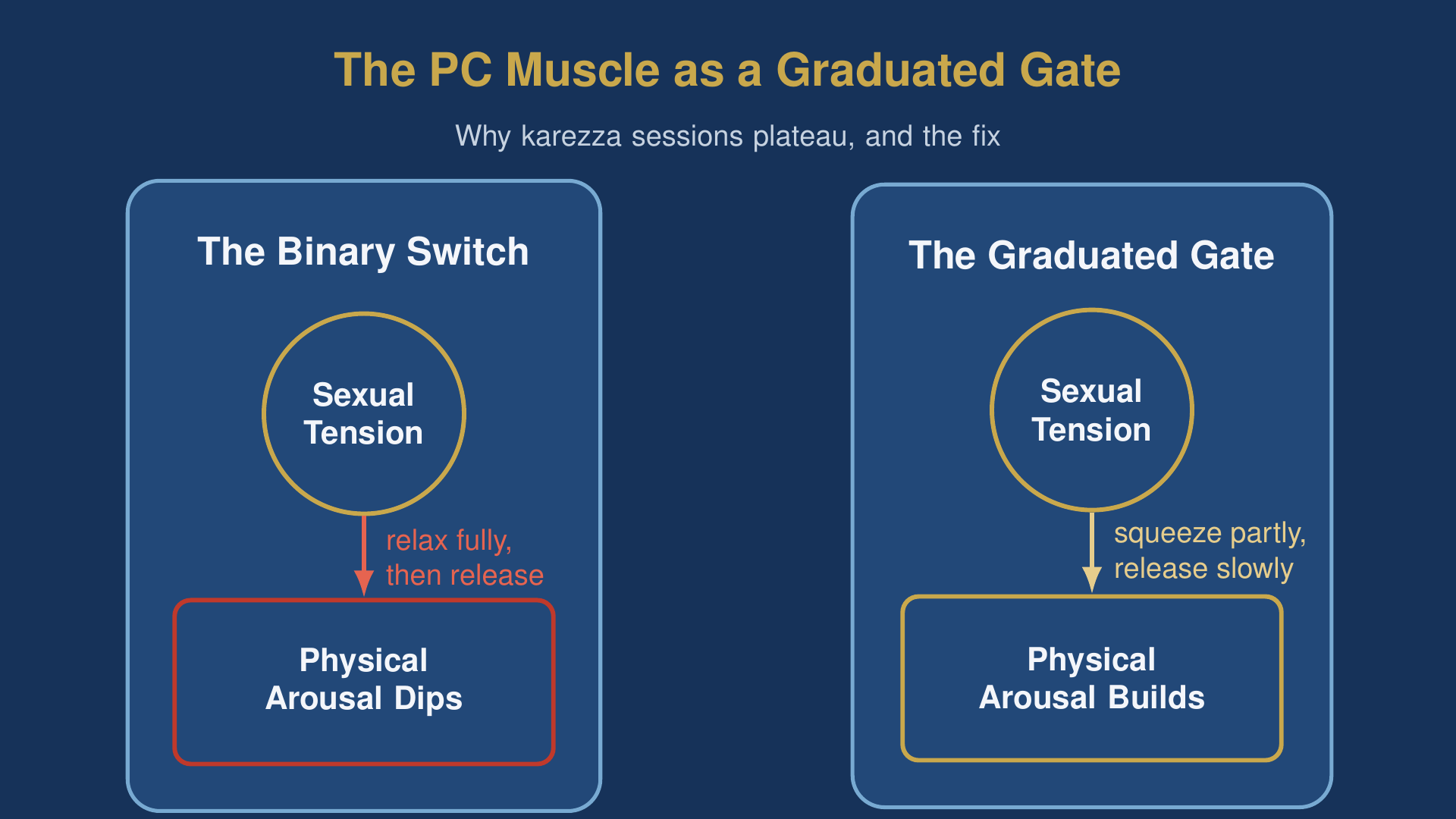
The book that describes this in full teaches it solo first, for a simple reason: it’s easier to feel the difference between a full clench and a quarter clench when you’re not also tracking a partner’s pace. If you’ve never tried isolating your pelvic floor before, it’s worth finding that sensation on your own before bringing it into a partnered session. Once you can feel the difference reliably, here’s how it translates to karezza.
Here’s the technique, adapted from the book’s own gate mechanism for a partnered, slow-penetration karezza session:
- Move slowly and stay mostly still, as usual, until you notice arousal building toward the edge of your comfortable range. Not a specific number, just the point where you’d normally either need to move more or pull back entirely.
- Instead of fully relaxing or letting arousal keep climbing unchecked, gently and partially contract your pelvic floor, the same muscle you’d use to slow a stream of urine rather than stop it outright.
- Hold that partial contraction for a few breaths while staying still. Built-up tension doesn’t dissipate the instant you stop touching it any more than ordinary unresolved tension dissolves the moment its trigger ends; it settles rather than draining away.
- Release the contraction gradually, not all at once, and notice the small increase in sensation that comes through without the whole build-up draining with it.
- Repeat the cycle. Partial squeeze, hold, gradual release, each time letting slightly more sensation through while conserving what’s already accumulated, instead of resetting to fully relaxed between cycles.
- If a cycle releases more than you expected, let it happen. A release that comes after real buildup, the kind engineers call water hammer when it happens in a pipe, always lands harder than one you release early; that’s a sign the gate was doing its job, not a mistake to correct. Return to slow stillness and start the next cycle from wherever arousal settles.
The difference between a session that plateaus and one that keeps building isn’t more relaxation. It’s swapping one all-or-nothing switch for a dozen small, deliberate ones.
The Whole-Body Wave Has a Name: Sexual Awakening
Some people run the graduated squeeze correctly, cycle after cycle, and still get blindsided. There’s no unusual friction, no build toward a normal peak, nothing that looks like it’s escalating. Then, out of nowhere, a wave of sensation spreads through the chest, the thighs, the scalp, not concentrated anywhere in particular. It doesn’t feel like a normal climax. It’s startling, sometimes disorienting, because it doesn’t map onto anything anyone told them to expect.
That’s not a fluke, and it isn’t something going wrong. It has a mechanism, and it comes directly from how sexual tension gets stored and spent. Ordinarily, physical arousal and mental arousal climb together, with the pelvic floor doing the releasing, which is why climax normally feels localized. But when a big enough spike in mental arousal (an intense image, an unexpected shift in sensation, anything sudden) lands while a lot of sexual tension has already accumulated and physical arousal is still low, the body doesn’t wait for the pelvic floor to catch up.
It closes the gap directly, converting stored tension into physical arousal all at once. Because the usual outlet was never engaged, the surge doesn’t localize there. It spreads through the whole body instead. The book calls this Sexual Awakening: an internal, whole-body climax rather than a genital one.
Think of it as fuel and spark: sexual tension is the fuel, and whatever sudden shift in mental arousal triggers the release is the spark. A huge reserve of tension with no spark just sits there quietly. A strong spark with no tension behind it produces an ordinary, localized peak. It’s only when a real reserve meets a real spark that the release stops being local and turns into something closer to whole-body.
None of this has been measured directly in a lab under that name; the book itself is upfront that sexual tension, defined this precisely, hasn’t been studied as its own variable. But the pieces it’s built from are well established.
Unfulfilled arousal doesn’t dissolve the moment a session pauses, it runs on the same anticipatory reward circuitry that operates on wanting rather than having, and testosterone helps keep that drive elevated across a long, non-ejaculatory session. A sudden, disproportionate release after sustained buildup isn’t a strange exception to how arousal works. It’s closer to the rule.
If it’s happened to you already, that whole-body wave wasn’t random. It was accumulated tension finding an outlet other than the one you were braced for.
Share the Karezza Fix
If you know someone who’s tried karezza, hit the same plateau, and been told to just keep going for a few more weeks, send them this. The graduated-gate cycle above is complete on its own: they can run it during their next session without anything else.
That cycle is enough to get you through a single karezza session and past the plateau. The book’s fuller system builds on it: carrying accumulated tension across an entire day, stacking it session after session with the complete resonance workflow that lets you widen the gate on purpose, and the full mechanics, math included, behind the whole-body wave some of you just recognized. That’s Arousal State, worked out in full.