Stop blaming testosterone or the seven-day theory. None of that addresses what’s actually happening after you finish: your body needs one kind of recovery, your desire needs a completely different one, and treating them as the same wait is why nothing on any list has worked twice in a row.
You’ve probably tried some combination of the standard advice already: ice, deep breathing, staying physically close to your partner, waiting out a fixed window before trying again. Some nights one of those works. Other nights the exact same routine gets you nowhere, and there’s no obvious reason why.
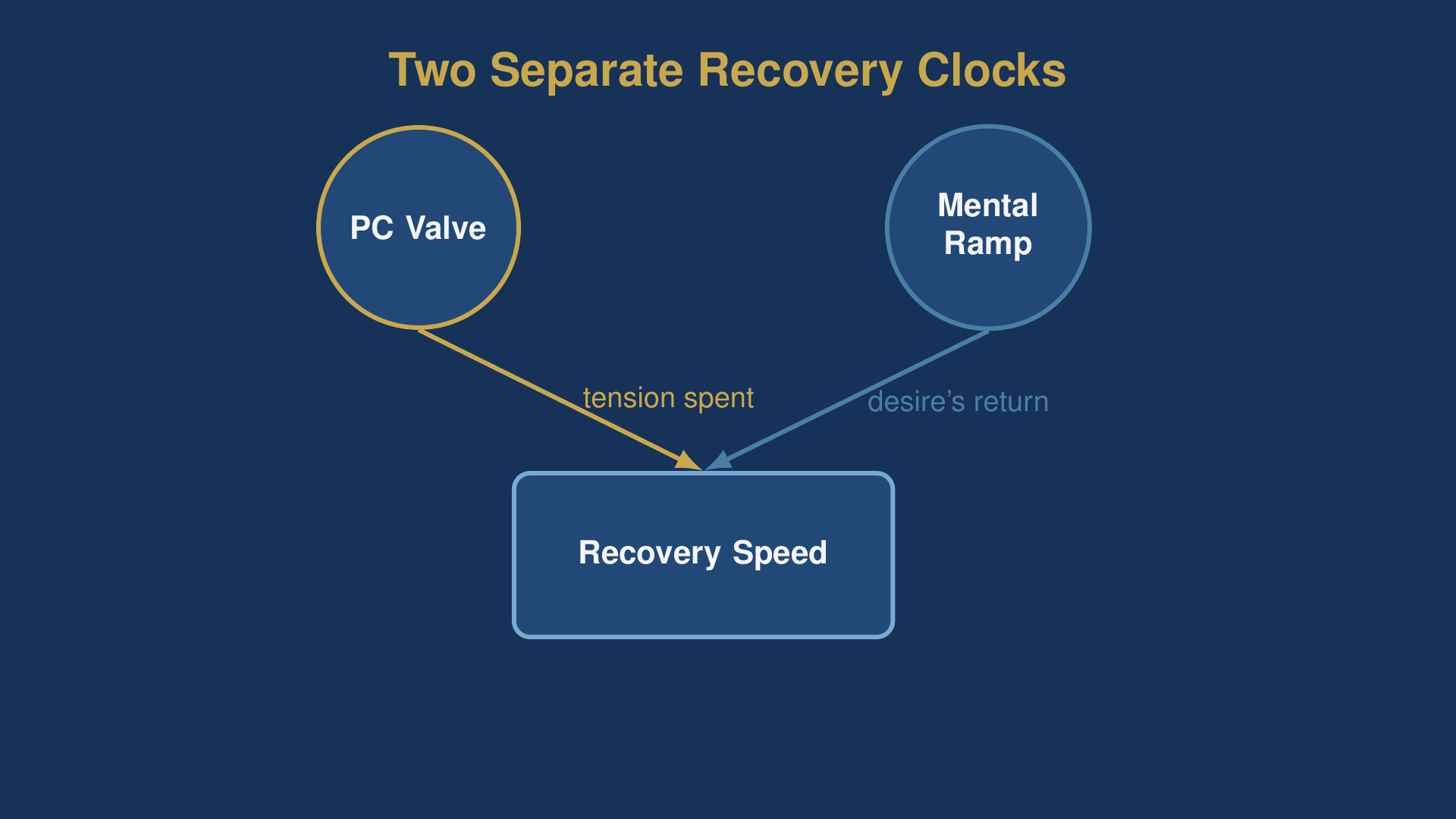
The refractory period was never one clock counting down. It’s two separate systems, recovering on two different schedules, and every list of tips you’ve read has been trying to speed up both of them at once, with the same trick.
Every top-ranking page for how to shorten refractory period runs a version of the same checklist, an ED medication, Kegels, a position change, deep breathing, hedged heavily with “may help” and “talk to your doctor,” and treats the whole recovery as one thing to nudge. None of them separate what your body needs from what your desire needs. That gap is what the rest of this closes.

How to Shorten Refractory Period: What’s Actually Happening After You Finish
Following climax, the body enters what’s clinically called a refractory period: a stretch where sexual arousal and function are measurably lower than they were minutes earlier. How long that stretch lasts varies enormously between men, and even within the same man from one night to the next, shaped by age, fitness, and baseline hormonal profile.
The internet’s favorite fix for this is timing: wait seven days, and testosterone supposedly spikes enough to reset everything. That claim traces back to a small 2003 study that reported a temporary 45 percent jump in testosterone on day seven of abstinence. It’s never been replicated. Larger, better-controlled studies have since found testosterone staying essentially stable across days of abstinence, a result a more recent crossover study on post-ejaculation hormonal response has since backed up.
If you’re waiting on a hormone clock to hit some magic number, you’re waiting on a number that was never really there.
None of this means recovery time is random, though. It just means the variable that actually moves it isn’t a hormone level rising and falling on a calendar somewhere in the background. It’s how the last release was handled, and what your attention does in the minutes after.
So if it isn’t a hormone timer, what actually varies night to night? Two things, and they don’t run on the same schedule.
The First Lever: How Much a Release Actually Spends
Here’s what most guides never mention: a release isn’t a fixed, all-or-nothing event. Your body has a graduated valve for it, your PC muscle, part of the pelvic floor group with a documented, trainable role in sexual function going back decades, the same muscle that stops your urine stream mid-flow. Relax it completely at the moment of climax and everything that built up gets spent in one uncontrolled event. Keep even a little control in that same muscle through the moment of release, and only part of what built up actually discharges.
Think of it the way you’d think of a dam: sexual tension is the pressure built up behind the wall, and the PC muscle is the outlet. Open the outlet fully and all the pressure escapes at once. Open it just a fraction and most of the pressure stays exactly where it was. The same control the book teaches for building toward a bigger peak works in reverse too: used at the moment you actually finish, it keeps the release smaller, and a smaller release is less for your body to recover from afterward.
Try this the next time you’re close:
- As you approach the point of climax, don’t fully relax everything at once. Gently squeeze your PC muscle, just enough to blunt the force of the contraction.
- Hold that partial squeeze for a few seconds while stimulation continues, instead of letting go all at once.
- Ease the squeeze open gradually rather than releasing it in one motion, so tension escapes in a smaller amount than it otherwise would.
- Let the finish be the smaller, more contained version of itself, not the full-force, uncontrolled one.
You’ll feel it when you get it right: the sensation still peaks, but it doesn’t fully drain, more like a wave that crests and only partly breaks. If nothing feels different from your usual finish, you squeezed too late or too lightly to matter, so ease in a little earlier next time. This isn’t about denying yourself a real climax. It’s about choosing, on purpose, how much of what you built actually gets spent in that one moment.
The valve was always adjustable. Most men have only ever used it fully open.
The Second Lever: Why Desire Lags Behind the Body
Physical arousal and mental arousal don’t come from the same place. Physical arousal runs largely through spinal and peripheral pathways, the reflex circuitry that drives blood flow into an erection almost automatically. Mental arousal, the part of you that actually wants this to happen again, runs through cortical and limbic circuitry instead, the same regions behind attention, motivation, and emotion. Most of the time these two move together. Right after you finish, they don’t have to.
That’s the part every generic list misses: it assumes that once your body is ready again, you will be too. But mental cues alone produce weaker, less consistent arousal than direct stimulation does, and after climax, desire itself can sit flat for a while even once the physical machinery has technically recovered. Waiting for your body to feel ready is checking the wrong system.
There’s a real mechanism behind why deliberately engaging your attention works better than passively waiting it out. Sexual activity temporarily suppresses the brain’s dopamine response, and it’s a period of abstinence, or more precisely renewed anticipation, that lets it recover and even sensitize sexual drive again. In male rodents, anticipating a mate is what spikes the dopamine driving mating behavior in the first place, not the passage of time on its own. Passive waiting gives that system nothing to anticipate. Deliberately directing your attention toward something that excites you does.
The book’s fix for this, called the mental ramp, works whether you’re building arousal for the first time or trying to re-ignite it after finishing:
- Instead of checking your body first, deliberately shift your attention toward whatever specifically excites you: a memory, an image, a fantasy, anything that’s worked before.
- Hold that thought on purpose rather than letting your attention drift back to what your body is or isn’t doing.
- Watch for a small, involuntary tell: a shiver, a catch in your breath, a faint muscular twitch. That’s mental arousal ramping, and it shows up before the physical response does.
- Let your body follow that signal instead of leading with it. The physical response comes after, not before.
Desire doesn’t wait for your body to give it permission. It works the other way around.
Why the Same Routine Feels Random
This is why identical nights produce different results. Some nights your body is genuinely the slower system: a big, full-force release the first time means the physical lever needs more time, straightforwardly. Other nights your body is ready almost immediately and it’s desire that’s sitting flat, which no amount of extra waiting fixes, because waiting only ever worked on the physical lever to begin with.
Generic advice can’t tell these apart because it was never built to answer how to shorten refractory period, only to fill a checklist. Ice and deep breathing address the physical lever, at best. An extra day of abstinence bets entirely on hormones that, as the retracted myth shows, were never actually the variable in play. None of it asks which system was the actual bottleneck that particular night.
There’s also a real limit worth naming honestly: this isn’t a case where faster is always better. The same inverted-U pattern that shows up across physiology applies here too. Too little time between rounds and too much withheld tension can both work against you. The goal is matching the technique to the actual bottleneck, not maximizing speed at any cost.
The two levers also reinforce each other. Tension you deliberately bank with the first lever doesn’t just mean a smaller release, it keeps attention and motivation oriented toward sexual cues instead of dropping to zero the way an uncontrolled release does, the same anticipatory pull behind sexual motivation more broadly. That’s a head start on the second lever before you’ve deliberately used it at all.
Once you know which lever is slow tonight, you stop guessing and start choosing the technique that actually fits it.
If you know someone who’s run through the whole checklist, ice, breathing, the seven-day wait, and still gets wildly inconsistent results, send them this. Both techniques above are complete as written: figure out which lever is actually slow tonight, and use it.
Both levers here work as standalone techniques, tonight, on their own. The book is what happens when you stop treating them as separate fixes and start running them together on purpose, across a whole session, so how much you spend and how fast desire returns are both things you’re deliberately controlling instead of two things you’re hoping happen to line up: