Press hard enough at the right second and it feels like you caught yourself just in time. You didn’t. By the time your fingers land, the decision already got made half a second earlier: all pressure does now is choose which direction it goes.
That’s not what either side of the debate around this technique will tell you. One camp calls it the Million Dollar Point: press hard on the perineum pressure point, the spot between your anus and testicles, right as you’re about to finish, and you can delay it, or stack a second wave on top of it. The other camp calls it a bad idea, warning that forcing fluid the wrong way can hurt you. Both sides are describing the same motion. Neither one asks what’s actually happening in your body at the exact second you press.
Every ranking piece for this exact search does the same thing: explain where to press, explain when to press, then argue about whether it’s a shortcut or a risk. None of them explain why it works some nights and does nothing on others, because none of them look at what’s already happened in your body before your fingers ever get there.
The debate has never been about whether pressing the perineum pressure point works. It’s been about a moment that’s already over by the time anyone presses anything.
The reflex fires before your fingers ever get there
Ejaculation isn’t one event. It’s two. First comes emission: seminal fluid moves into the urethra, and the neck of your bladder closes to keep everything moving in one direction, out. Only after that does expulsion happen, the visible, rhythmic contractions that actually push it out. Research on the reflex describes it as exactly that, a two-phase process, where the first phase is already a done deal by the time the second one is visible from outside your body.
The book’s framework calls the moment emission locks in the Point of No Return, and treats that threshold as binary, not gradual. Once you cross it, “ejaculation becomes inevitable even if stimulation stops,” and what follows is a complete loss of voluntary control. Not a fuzzy edge you can talk your way back from mid-sentence. A line.
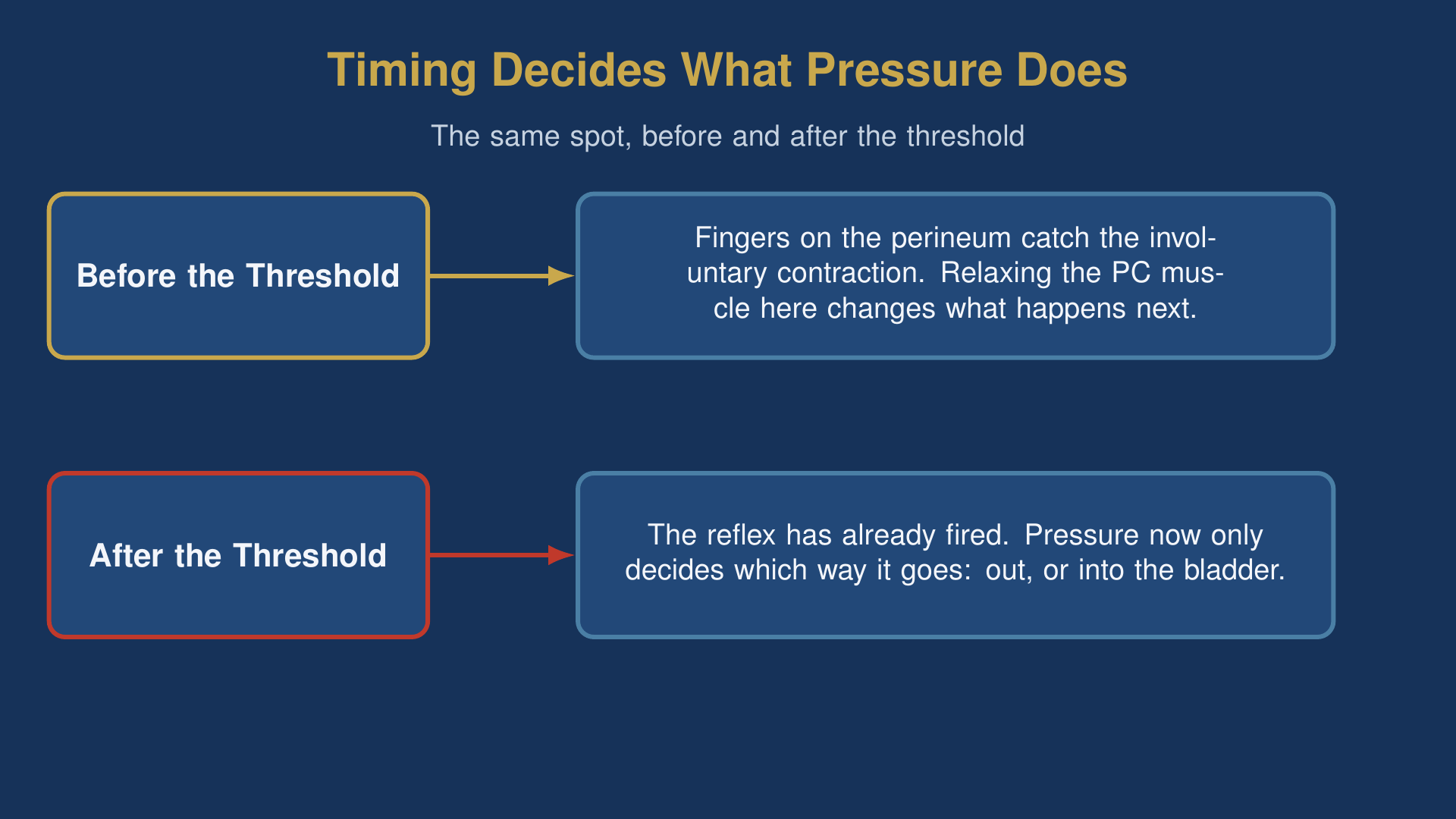
Here’s what neither camp in the online debate accounts for: pressing the perineum pressure point hard, at the moment you’re taught to press it, happens after that line, not before it. Your body isn’t asking permission anymore.
It feels like a clean stop when you do it. No mess, no visible finish, like you shut the whole thing down at the last second. You didn’t shut anything down. Emission had already moved fluid past the point where your body can call it back, and expulsion still ran its full course inside you. Blocking the exit doesn’t cancel that, it just closes the door your body was already pushing toward and leaves the fluid one other way out: backward, into your bladder, where insufficient closure at that exit is exactly what redirects it there. You’ll likely notice it later, cloudy urine the next time you go. You didn’t outsmart your body. You relocated the mess.
The safety-scare camp gets one thing right and one thing wrong. Retrograde ejaculation itself is real, boring, and not something you’ll notice beyond that one detail: your body clears the fluid on its own, no lasting effect. What the same camp usually adds on top, that pressing here repeatedly risks nerve damage, isn’t something the clinical research on this exact technique actually backs up. It gets repeated because it sounds cautious, not because anyone measured it. The honest complaint against pressing hard here isn’t injury. It’s that it does nothing close to what either camp promised.
You didn’t stop anything. You rerouted it, and neither side of the online debate is arguing about that.
The perineum pressure point, used earlier, does something else entirely
There’s a version of this that actually works, but it has nothing to do with pressing hard at the end. It’s about using the exact same spot earlier, as a sensing point instead of a brake.
As you get better at reading your own arousal, the gap between “close” and the Point of No Return gets finer, not vaguer. You start being able to get closer and closer to that threshold, arbitrarily close, without crossing it, as long as you never actually cross the line. That precision is the entire game. Pressing doesn’t get you it. Feeling does.
The book’s own instruction for building that precision is almost embarrassingly simple: rest a couple of fingers, middle and ring work well for most people, on the perineum, between your anus and testicles. Not pressing. Resting. Done consistently, this lets you feel even the subtlest involuntary contraction, the same way you’d feel a pulse under two fingertips.
That’s the entire reframe. The Million Dollar Point isn’t a brake you slam at the last second. It’s a gauge you should have been reading the whole time.
Most men who try a live-timing technique like this give up on it within a session or two, not because the timing skill is impossible, but because they’re trying to feel an internal muscle they’ve never consciously located, while aroused, for the first time. An external landmark removes that problem. You’re not guessing whether that flicker was the right muscle. You’re feeling it happen under two fingers that aren’t going anywhere.
The same two fingers everyone presses hard at the end are the ones the book has you rest lightly, the whole time, to feel the threshold coming instead of slamming into it.
The sensing-and-release method
Here’s the actual method for using the perineum pressure point, the one both sides of the online debate skip past:
- Build gradually. Start stimulation and let arousal climb at a normal pace rather than rushing straight to the edge. You need room to notice small changes, not just the big obvious one at the end.
- Rest two fingers at the perineum. Off-hand, middle and ring fingers, resting lightly between your anus and testicles. Not pressing. You’re not blocking anything. You’re listening.
- Wait for the flutter, not the full contraction. As arousal rises, keep your attention on that spot. You’re feeling for the earliest involuntary twitch, a warning tremor distinct from the deliberate, full-body contraction that happens right at expulsion. It shows up before the point where stopping stimulation wouldn’t matter anymore, not at it.
- Relax, don’t clench, the instant you feel it. This is the reverse Kegel motion: ease the PC muscle open, the same sensation as encouraging a urine stream to flow faster rather than stopping it. Keep the movement isolated to the PC muscle itself, not your abs, glutes, or thighs. Hold the open position for about five seconds, then return to neutral.
- Read what just happened. If stimulation still feels completely safe to continue, you relaxed early, and arousal can climb further before your next catch. If you still felt the contraction land anyway while you were relaxing, you were late. Catch it sooner next round.
- Repeat, narrowing the gap each time. Every round is a chance to feel the tremor a little earlier and relax a little more precisely, not just repeat the same rough guess.
The method isn’t pressing hard once. It’s resting two fingers lightly, then relaxing on purpose the instant you feel the earliest signal, before the full contraction ever arrives.
How to tell you caught it, not just delayed it
Your body gives you a clean readout on whether the timing landed.
Relax too early and the sensation hits what feels like a stiff wall, going flat instead of building. There wasn’t anything there yet to redirect. Relax too late and you’ll feel the contraction land anyway, already underway before your release catches up to it, and sexual tension drops instead of climbing. Get the timing right, and the sensation seems to reverse direction entirely: instead of releasing outward, it slingshots back inward, and sexual tension builds rather than empties out.
None of this needs to land perfectly the first time, or the fifth. Some rounds you’ll feel the flutter and relax a half-second too late anyway. That’s not failure, it’s information about which direction to adjust next time. The two fingers resting at the perineum are what make that adjustment possible at all. Without them, you’re guessing at a feeling. With them, you’re reading a signal directly.
Give yourself more than one attempt per session before drawing any conclusion. The first round mostly tells you where your attention was pointed. The second and third are where the timing actually starts to sharpen, because you now know roughly when to expect the flutter instead of searching for it cold.
A stiff, flat wall means you were early. A contraction you still feel land means you were late. A sensation that reverses direction and builds instead means you got it.
What one accurate catch turns into
Tonight, the goal is small on purpose: catch that flutter once, on purpose, and relax through it instead of pressing against it. That already works on its own. You don’t need anything past this to use it again next time.
But once you can catch it reliably, on demand, a different question opens up. What happens if, instead of relaxing once and letting the moment pass, you use that same signal to build past it deliberately, cycle after cycle inside a single session, banking sexual tension instead of just avoiding a mess? That’s not the sensing skill you just learned. It’s what you do with it once sensing stops being the hard part.
Catching the flutter once already works. Everything past that, cycling it deliberately across a whole session, is the deeper skill.
If you know someone who’s read the Million Dollar Point advice online, tried pressing the perineum pressure point hard once, and couldn’t tell whether it worked or just confused them, send them this. The method above is complete without anything else: two fingers, the flutter, the release, and a way to check whether the timing landed.
For the deliberate version, opening and closing that same gate on purpose across a full session instead of catching one flutter and stopping, that’s the system Arousal State builds out in full: