In January 2024, partway through a log I was keeping on my own pelvic-floor practice, I wrote myself one line. I’d finally named something I’d been circling for months without a name for it:
longevity = reps, intensity = weight, keeping the PC muscle from moving involuntarily = form
I was doing crossfit five mornings a week that winter, and the barbell language did in one line what the months before it hadn’t managed. It split one blurry practice into three separate things I could train.
Almost every list of ejaculation control exercises online is missing that split. Pick an item off the list, a Kegel squeeze, a round of start-stop, a jog for general fitness, repeat it, and the repeating itself is the whole assignment.
Ejaculation control exercises are three separately trainable variables under load: the length of time a plateau holds, how much stimulation you can take before backing off, and how still your pelvic floor and the rest of your body stay while you do either. Blur the three together and progress stalls, because you can’t tell which one broke. Split them the way a lifter splits reps, weight and form, and every session hands you a number to beat.

Ejaculation Control Exercises Are Already Three Exercises
The muscle behind all of this is the PC muscle, part of your pelvic floor. You’ve felt it every time you’ve cut off your urine mid-stream. Fire it at the wrong moment and it’s what propels everything out during climax; relax it well at the right moment and you can hold off that firing far longer than you’d guess.
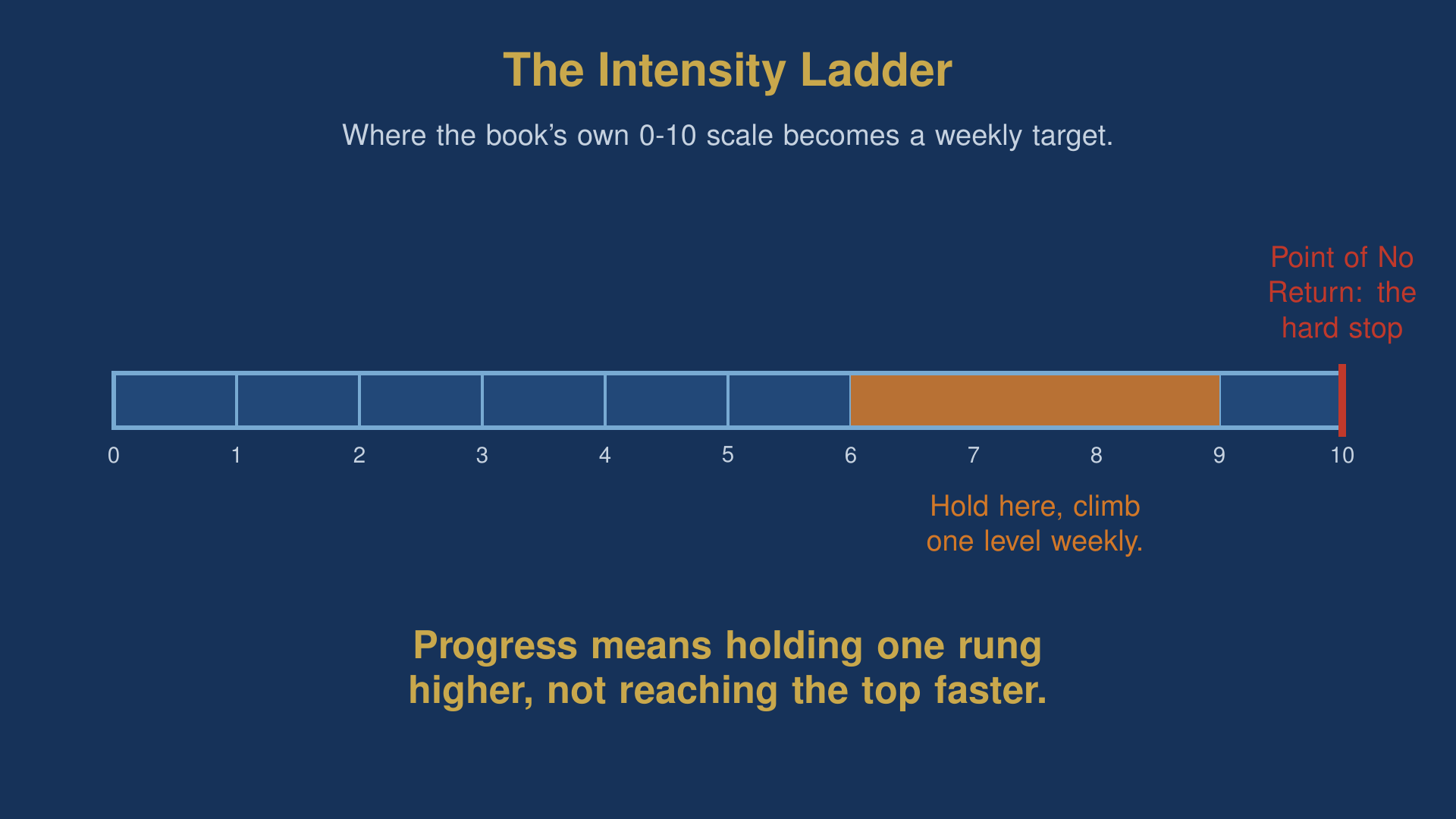
Physical arousal in my book runs on a 0-10 scale: lengthening, swelling, hardness, heat, and at 10 the threshold past which nothing you do reverses it. Ejaculation control exercises change how long you can sit up at 8 or 9 without tipping over, and how much stimulation you absorb while you sit there.
What surprised me when I went back to my own source material was that the Kegel progressions in the book had already made the split: increase repetitions, increase hold time, increase intensity, with proper form, staying out of the abdominal, glute and thigh muscles, as the constraint that keeps the other two honest. Reps. Weight. Form. I put a barbell’s name on three dials the book had already laid out one by one.
Reps, weight and form is my own shorthand. The book lists the three Kegel progressions as separate options and leaves them unnamed; the barbell vocabulary is how I keep them straight in my own head.
Train them one at a time, and log each one separately.
The Intensity Ladder, Step by Step
The procedure is the Intensity Ladder: one rung of arousal at a time, logging what happens on the way up. Give it twenty minutes, alone, with nothing after it you have to be on time for.
Before you start, find and isolate your PC muscle if you haven’t already (cutting off your urine mid-stream is the fastest way). You’ll also want to know what an involuntary contraction feels like right before you’d finish. If either of those is new to you, start there and come back to this.
- Warm up to a baseline. Start stimulation and bring yourself to a steady, moderate arousal, fully hard but well short of the edge, around the middle of the 0-10 scale. Hold there for a few breaths before you do anything else.
- Train reps: hold the plateau. Keep stimulation steady at that level and time how long you can stay there without climbing further. Catch it by relaxing and expanding the PC muscle every time you feel it starting to clamp on you, and when the plateau breaks, note the time. That number is what you train up over weeks, a rep at a time.
- Train weight: raise the level. Once the plateau breaks, push stimulation up one notch, closer to the edge, and hold again using the same release. Your target each week is one level higher than the week before. The top rung will still be there in a month.
- Train form: check what else moved. After each hold, ask what moved that shouldn’t have: hips thrusting, thighs clenching, breath catching. The physical arousal response is leaking out through a different muscle group because the PC muscle didn’t catch it. Isolate the PC muscle only, and keep everything else still.
- Log three numbers, not one. After the session, write down your best hold time (reps), the highest level you held cleanly (weight), and whether your form broke before your time or your level did (form). The next session’s target is one of the three.
- Stop clean at the threshold, every time. However close you get, if a contraction starts that you can’t reverse, you’ve hit the point of no return. Stop, don’t fight it, and log where it happened. That boundary is data too.
The rungs near the top move in small steps by design. The book approaches the threshold by climbing to hardness, easing into heat, then adding just enough extra stimulation to test whether that increase is the one that tips you over. The ladder runs that careful approach again and again through a full session.
Progressing this way, session to session, is my own applied practice, logged over months of my own training, with no published protocol behind it. What it gives you is something almost no list of drills gives you: a way to tell, after twenty minutes, whether tonight beat last week.
Why the Ladder Works
The pelvic floor, the PC muscle among those muscles, is the muscle group central to erectile and ejaculatory function. Which is why the practice targets it directly, and why isolating the PC muscle, the form variable, carries as much weight as the other two. A hold that leaks into your hips and thighs is the same response finding a different exit.
The progressive-loading logic behind reps and weight has a long paper trail. The Kegel exercise comes out of a 1948 paper on progressive resistance exercise for the perineal muscles, and it is the logic strength training runs on generally: add a rep, add a hold, add resistance, and the muscle adapts to the new load.
That evidence covers pelvic-floor strength for erection quality and erectile dysfunction. A direct effect on ejaculation timing remains unproven. In my own practice the Kegel progressions build awareness and control of the PC muscle, and the timing comes from the release layered on top of them: relaxing the muscle at the moment it wants to fire. That release is mine to claim, and the studies don’t cover it.
The muscle itself is well established. What you do with it, holding a plateau for a measured stretch and writing the number down, is the applied layer built on top.
What Wrong Feels Like
Three failure modes in ejaculation control exercises show up more than any others, and all three come from skipping the split.
Clamping down when the plateau wobbles. The instinct is to squeeze the PC muscle harder, the way you’d tense up to stop yourself sneezing. Squeezing adds to the pressure that’s about to tip you over. The release, relaxing and expanding the same muscle, is what buys you time, which is why it gets trained as a variable of its own.
Jumping straight for the top rung. Skip from a comfortable plateau to the edge and you’ll either break form immediately or cross the threshold before you’ve learned anything. A session run that way produces one data point, that you finished, when it could have produced three: a time, a level, a form note. One data point tells you nothing about what to change next time.
Treating general fitness as the same exercise. A lot of the pages ranking for this phrase put a Kegel squeeze, a start-stop round and cardio or HIIT training on one list as interchangeable items. The pelvic floor muscles have a direct, specific mechanism connecting them to the PC muscle and to where the threshold sits. General fitness has no such line to it. It may well help your stamina and your confidence, and it leaves the muscle that governs the threshold untrained. Bundling the two buries the one that matters.
Every one of these collapses three variables back into one, which is the problem the ladder exists to fix.
What the First Real Session Tells You
Run the ladder once and you’ll have three numbers you didn’t have before: how long you held, how high you climbed, and which of the three broke first. Most lists of drills ask you to keep going and trust that it’s working.
The numbers won’t move together. Some weeks your hold time jumps and your form holds steady. Other weeks you’ll hold a new level clean while your best time at the old level drops, because your attention went to the harder rung. Three variables train at different rates, like a lifter’s bench and squat improving on separate weeks.
Catch a plateau and hold it because you decided to, and you’ll feel a specific beat the first time: you could have kept climbing, and you took the number instead. Repeat that across a session, and across weeks, and you have the practice.
The shift after a full ladder shows up in what you’re aiming at. You stop chasing “not finishing too fast” and start chasing a number: beat last week’s hold, hold this week’s level, or finish a session with your form intact. Walking into a session wanting that is a different thing entirely.
The ladder trains one dial on a board with four. My free email series walks through the other three, what stimulation does to your body, what your mind adds on top of it, and where the tension comes from when those two pull apart.
These exercises train one half of the skill: how far you can push before it fires. The other half is alternation, driving arousal up the way you just did and then easing off so the tension banks rather than spends, which is what lets a session keep climbing for an hour. Past that comes opening the same muscle by degrees, and spacing a week of sessions so the practice sharpens your response over time. All of that is in my book, from the first logs I kept in a notebook through to the model I ended up with, and the ladder is one rung of it.