Squeeze the head of your penis, right where it meets the shaft, hold firm pressure for ten to twenty seconds the moment you feel yourself getting close, then let go once the urge fades and carry on. Every page that teaches the squeeze technique describes it in close to those words.
The pinch is not what buys you the extra time. The sudden drop in arousal that pinching forces on your body is, and the muscle able to produce that same drop from the inside has been sitting in your pelvic floor the whole time, no hand required.
What the Squeeze Technique Actually Tells You to Do
Every health site describing the squeeze technique gives close to the same three steps: notice you’re getting close, reach down and press firmly on the head of your penis at the ridge where it meets the shaft, hold that pressure for ten to twenty seconds, then release once the urge to finish backs off and pick up where you left off.
It sounds like folk advice passed between men over the years, but it comes out of clinical sex research. Masters and Johnson documented it in 1966, in the same work that first mapped out the physical stages of arousal, and therapists have used a version of it in ejaculation-control programs for the six decades since.
What none of those pages explain is why pressing one spot on your penis does anything at all, when the sensation it interrupts runs through your whole body.
Why It Works: A Physical Dip, Not a Pinch
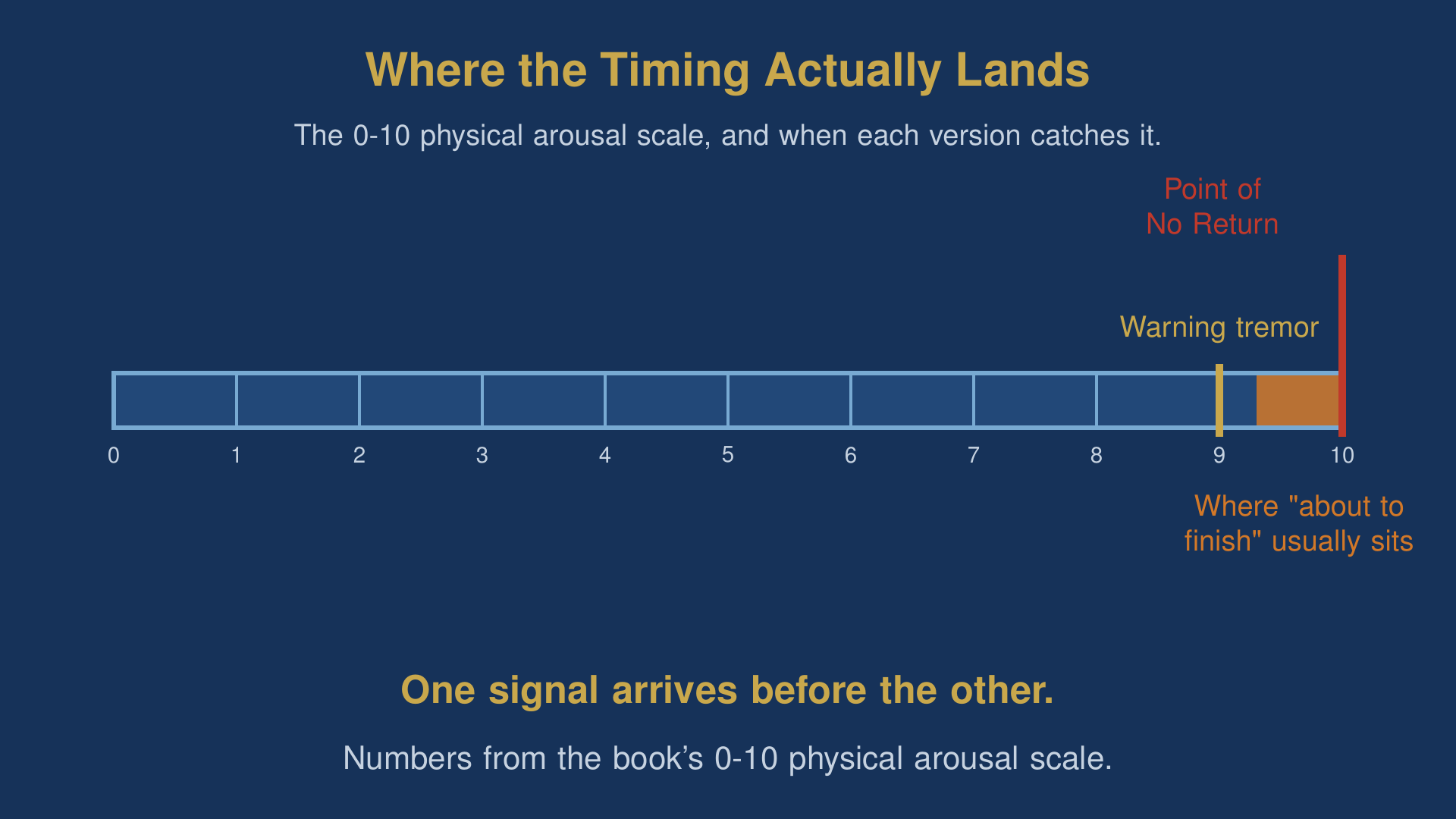
Picture physical arousal as a climb from zero to ten, where nine and a half is the edge, the place your body sits seconds before the ejaculatory reflex launches. Cross into ten and the ejaculatory reflex has already fired, which is the Point of No Return: ejaculation arrives whether stimulation continues or stops.
Squeezing the head of your penis doesn’t reset that number by magic. Sudden pain and pressure knock your arousal back a step, away from the edge, and anything that forces the same drop should buy you the same time, hand or no hand.
The health pages stop there. What they leave out is that your body already carries a muscle capable of the same drop from the inside: the pelvic floor muscle, the one you clamp down on to cut a stream of urine off halfway. It tightens as you approach climax, and it keeps an erection firm by pressing blood into place around the root of your penis. Let it go slack at the moment you would normally clench down, and blood drains back out, firmness eases, arousal dips, which is the same physical event the external pinch is forcing from outside.
A tourniquet and a blood-pressure cuff both wrap around a limb and press on it, and there the resemblance ends. A tourniquet is on or off: cinch it and blood flow stops completely, hard and all at once, which is why it belongs to an emergency and nothing else. A cuff inflates to whatever level you choose and lets down in small amounts, because it was built to be adjusted.
The hand squeeze is the tourniquet, and your pelvic floor muscle already does the cuff’s job, easing arousal down by as much as the moment needs and holding it there.
I’m reading the equivalence between the hand squeeze and this internal release myself. The book never analyzes the external squeeze at all; it maps the muscle’s role in arousal, and the comparison follows from that.
Where the Standard Version Breaks Down
Two things go wrong with the standard instruction, and squeezing wrong is neither of them.
The first is timing. The squeeze is timed to the felt urge to finish, and that urge often shows up after you have already crossed the ten mark, past the place where anything you do to your penis still matters. A faint involuntary flutter in your pelvic floor arrives a beat earlier than the full urge does, and none of the pages describing the squeeze mention it, so most men are watching for the wrong thing and reaching down after the window that would have worked has already closed.
The second is practicality. A firm ten-to-twenty-second squeeze needs a free hand and a full stop, which is manageable alone and much harder mid-sex, when a hand is often occupied or stopping outright would break a moment you would rather keep going.
The technique is also less dependable than the health pages make it sound. The same body of research backing it includes trials testing a web-based program and a stimulation device, and those found no real improvement over doing nothing at all.
The Version That Doesn’t Need Your Hand
Locating the muscle takes no training, since it’s the one you clamp to cut a urine stream off halfway. Rehearsing the release away from arousal, then catching the tremor when it counts, is the whole of the skill, and your hand stays wherever it already is.
- Rehearse the release at rest. Contract your pelvic floor muscle like you’re stopping your stream, then let it go slack, past neutral, the way it feels when you’re bearing down slightly. The looseness is the move, and the contraction is only how you locate the muscle. Practice a few times before you rely on it during arousal.
- Build arousal the way you normally do. Solo or with a partner, without cutting yourself off early.
- Watch for the tremor, not the urge. A faint involuntary flutter low in your pelvic floor arrives a beat before the full feeling of finishing does, and it’s the signal the standard squeeze instruction never names.
- At the first flutter, let the muscle go slack. Use the release you rehearsed at rest, right as the tremor is trying to happen, with your hand left where it already is.
- Slow the pace instead of stopping outright. The release is doing the pinch’s job for you, so keep moving at half speed while it lands.
- Once arousal eases back a step, pick the pace back up. Repeat as many times in the session as you want, with no pause at any point.
The first several tries will probably feel less certain than the pinch: a hand pressing down works on contact, while a trained release is a timing skill, and timing skills take reps before they hold up under pressure. A separate piece on catching that involuntary contraction covers the fuller timing skill this leans on, and another walks through training the release itself under real arousal before you need it mid-session.
What the Research Actually Found
A 2015 review of ten controlled trials on behavioral techniques for premature ejaculation found real gains in two of them, seven to nine extra minutes over a waitlist control, which is a substantial result for men who measure the difference in seconds.
Those two trials tested the squeeze bundled with stop-start and sensate focus together, and nothing since has isolated what squeezing alone contributes against the other two methods riding along with it.
This version addresses finishing that runs mostly on attention and timing. An underlying medical cause is a different problem: if nothing has budged after real weeks of practice, or if the timing has been the same since day one, that’s a question for a doctor rather than more reps.
Nothing Has to Stop for This to Work
The first time the release catches the tremor, nothing stops. Stimulation keeps going, the moment holds, and arousal eases back a step on its own terms, a controlled dip you can build out of a minute later.
Before you have to trust any of this mid-session, the free email series takes apart what rises and falls inside you while you’re aroused, which is what turns a move like this from a trick into something you can see coming.
Catching one tremor is a good first result, and it opens two harder questions: how to string several of these together across a whole session, when the first catch works and the next one slips away, and how to tell from the inside whether you’re building toward something bigger or postponing the same finish. The book I wrote answers both, built on the log I kept while testing every one of these moves on my own body.