The porn that used to get you there in under two minutes barely registers now. Your girlfriend does the same thing she has always done, the thing that used to undo you, and nothing happens. Then a woman who is basically a stranger walks past you on the sidewalk and gets more out of you in five seconds than either of them managed in an hour. You went looking and found a name for it: the Coolidge effect, supposedly wired into you to keep chasing something new.
What went quiet is your attention to one specific, unchanging cue, not your capacity to want the person or the material in front of you. A new stimulus is one way to snap that attention back on, and it is the crudest one. The same jolt can be triggered without changing what, or who, you are looking at.

The Novelty Prescription
You have probably already met the standard version. It comes from an old story about a rooster: introduce him to a hen he has mated with repeatedly and he loses interest, swap in a new hen and he is back at full strength within seconds. The animal literature built a term out of that story, the Coolidge effect, and most definitions of it say roughly the same thing, that males show a renewed burst of interest for a new mate while females show it “to a lesser extent.” Translated into advice for you, that becomes a shopping list: new partners, new material, new positions. Your biology, the story goes, only answers to something it has not seen yet.
That “lesser extent” is doing more work than it gets credit for. Women show the renewed interest too, at a lower rate, which makes the clean male-wiring version of the story shakier than it sounds when someone tells it to you. The hormonal research behind the effect describes itself as unsettled, several candidate mechanisms with no agreement among them, so the biology underneath the joke is a good deal messier than the prescription built on top of it.
None of it helps with a cue that has gone flat on you.
What the Coolidge Effect Wears Out
Your body responds to a cue, and a cue is smaller than a person: an angle, a sound, an opening sequence, the way she puts her hand on your back at the same point every night. The book’s own model treats mental arousal as erratic, spiking and crashing on instantaneous thoughts, perceptions and emotions, running on whatever your attention happens to land on in a given second. Hold one cue constant, night after night, in the same order, at the same angle, and your attention has less new information to grab each time, so the response comes back flatter. Change the cue and it has something to catch on again.
A tuning fork struck against a fresh spot on a wood block rings out sharp and clear. Strike it again on the spot it just hit, moments later, and it damps out almost before it starts, because that spot already absorbed the last strike. Hit an untouched spot an inch away and it rings full again. Your attention behaves like the block, and the cue you have run a hundred times is the spot that already took the strike.
The evidence for this in men is direct. Sixteen men watched the same erotic film segment over repeated trials; their physical response and their sense of being absorbed in it both fell away, and both came back the moment the film changed. Rats and burying beetles get cited constantly on this topic. That study measured men.
The cue went quiet, and you didn’t.
One thing gets lumped in here and belongs in its own box. An endless supply of new porn works on a rising bar, meaning how much novelty it takes before anything registers at all, which is a bigger and slower problem than one repeated cue going quiet. The local version is what this article treats. Both travel under the same name.
Why It Reads as Hardwired
The biology people point to as proof comes from rats. In male rats, the dopamine surge that normally fires during sex with a given partner stops firing once the animal has been sated on that same partner. Nobody has run that scan on a man in your situation. What we have in men is arousal and attention declining on repeat exposure and coming back on something new, which points the same direction without being the same study, a rat’s brain chemistry standing in for your evening.
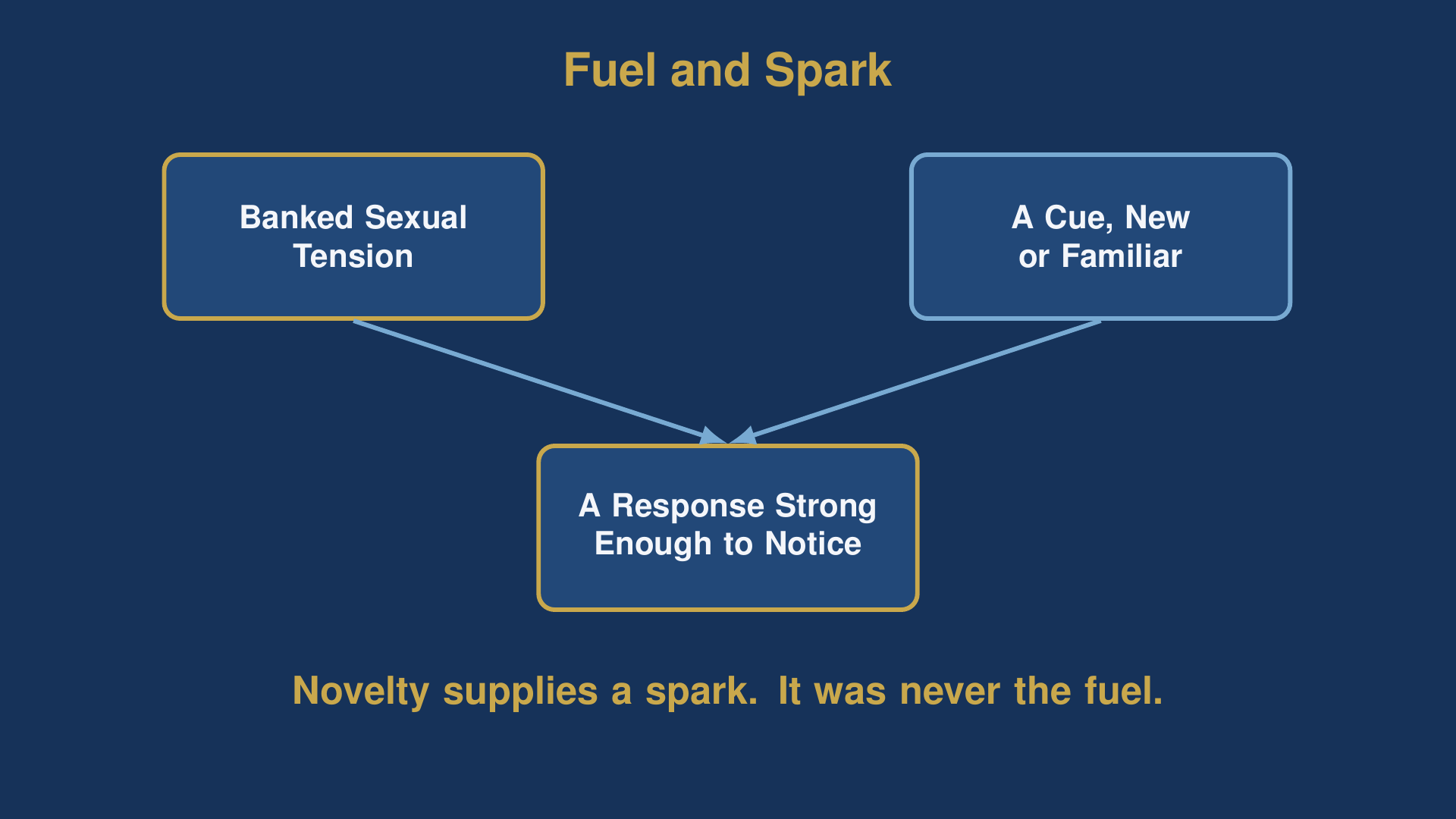
I think the popular reading gets the causation backward. That link between the Coolidge effect and the book’s own material is my reading; the book never uses the term. What the book does describe is a spark, the event that sets banked tension off, and a stranger catching your eye is one kind of spark. For years that was the kind that mattered most to me. The same pages list a long-term partner, an absorbing conversation, a moment of eye contact across a room. What the stranger has going for her is unfamiliarity, and unfamiliarity catches your attention cold, before habit has a chance to file her.
A spark needs fuel to ignite anything, and the fuel is the sexual tension you were already carrying when the cue arrived.
Recharge a Cue That’s Gone Quiet
This works alone or with a partner, on whatever specific thing has stopped landing: a partner, a routine, a piece of material. Give it twenty to thirty minutes of unhurried privacy. What it retrains is a cue that has stopped registering. If the relationship itself is the thing that went flat, unresolved resentment, distance, a fight that never got closed, no amount of retrained attention touches that. Attention you are avoiding is a different job from attention that has gone quiet.
- Bank some tension before you touch anything. Let arousal sit for a few hours, or since your last release, so there is something in reserve when you start. Building mental arousal from a cold start is the same job when nothing external is doing it for you.
- Pick one detail of the cue you have stopped noticing. A look, a sound, a line, a part of the routine. Give it your full attention, as if it were new, and stay on it past the point where habit would have scanned by.
- Watch for the small involuntary tell. A held breath, a shiver, a sudden pull in your chest, a twitch. It is the reflex that fires when something catches you off guard, only fainter, the same jerk a reflex hammer gets out of your knee. Small is what you are looking for.
- The moment you catch that tell, stay with it. Hold the attention that produced it a little longer before moving on to the usual finish.
- If nothing fires on the first attempt, change a single variable. How you are touching, or where you are looking, while the rest of the scene stays where it is. Identical input every time is what goes quiet fastest, which is the principle behind varying how you touch.
- Expect this to strengthen over several attempts. You are retraining a response, and night one will not match a brand-new spark catching your eye cold. How far short it falls has never been measured by anyone. It does put a signal back where there was static.
The Twitch That Tells You It’s Working
The first time the old cue produces that tell again it will be small, a caught breath or a shiver, the knee-jerk with the volume turned down. It will also be yours, pulled out of you by something you already own.
A free series of emails goes under the hood of what you just read: how desire gets built in your head, what the body does with the pressure once it is there, and why those two stop talking to each other on a cue you have run a hundred times. Banking sexual tension ahead of a session is in there too, so something is held back for when a cue lands.
You have felt the twitch come back on a cue you had written off, and the next question is what to do with a body that will do that on command. The book I wrote covers the rest of it: building a reserve of desire ahead of time so an ordinary Tuesday evening still hits hard, holding a response like that across a whole session, and telling, session to session, whether what you are doing is working. Years of experiments with a single subject, me, written up alongside the model behind them.