You’ve probably already tried some version of the edging technique: pull back a few times before finishing, feel something building that you can’t quite name, then lose whatever it was the moment you actually finish. Most articles about the edging technique never mention that unnamed thing. They circle back to stamina and stop there.
The pause at the center of it isn’t new, and it isn’t mine. In 1956, urologist James Semans described what he called the stop-start method: stimulate close to orgasm, stop, let the urge pass, then repeat, developed as a treatment for men who reached orgasm sooner than they or their partners wanted. What most people now practice as the edging technique is that same clinical pause, borrowed from a treatment protocol and repurposed as a general habit. The framing has barely moved since Semans: a tool for control, exercised for someone else’s benefit.
That framing isn’t wrong. It’s just incomplete. Sex therapy had no reason to ask what happens to a man’s internal state when the same pause is repeated alone, with no partner present and no ejaculation as the goal. That question is what the rest of this article, and the framework behind it, exists to answer. Practiced this way, the edging technique stops being a delay tactic and becomes something closer to a method for deliberately accumulating a state most men never approach.

What the Edging Technique Actually Trains
Physical arousal is the easy half to observe. It moves through recognizable stages, lengthening, swelling, hardness, and finally the heat just before the point of no return, and your body gives fairly precise feedback about where you sit on that scale.
Mental arousal is subtler. It’s the internal charge of desire: the pull of attention, the intensity of fantasy, the sense that everything feels more alive. Unlike physical arousal, it doesn’t track stimulation directly. It tends to sit flat at low physical levels, then surge sharply as you approach the edge.
Under ordinary conditions, the two rise together and resolve together in ejaculation. That coincidence, mental and physical arousal peaking at the same instant, is the default experience, which is also why most men never notice they’re separate quantities at all. The edging technique interrupts that default. By pulling back before the point of no return, you let physical arousal drop while mental arousal stays elevated. The gap between them, what I define as sexual tension, keeps building instead of collapsing.
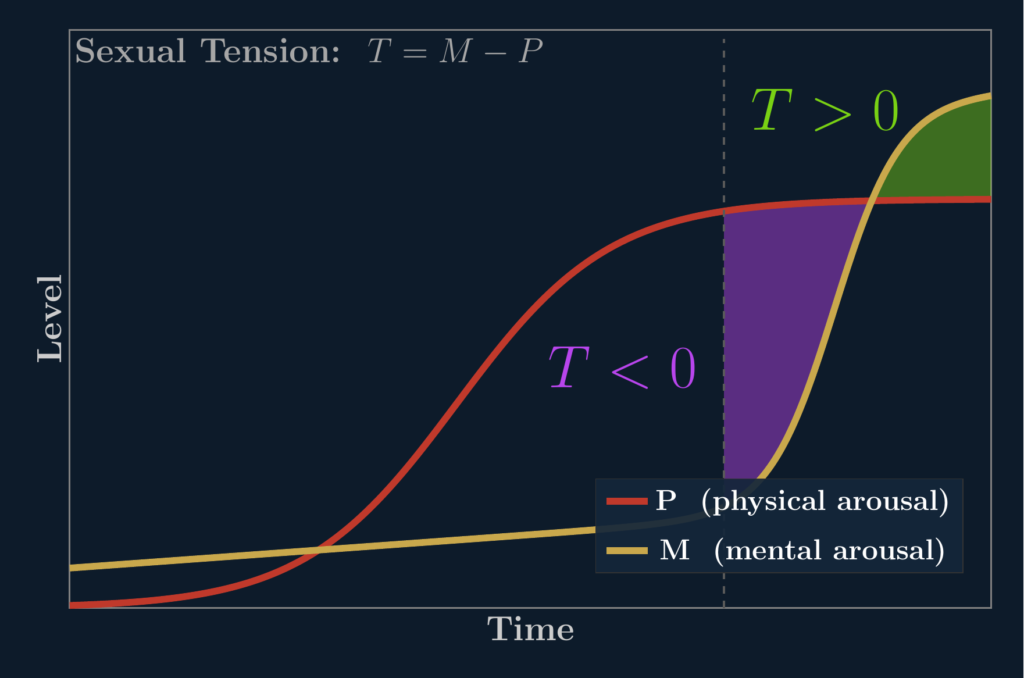
Picture a pressure cooker. Rising mental arousal raises the temperature inside. Your body’s default response is to vent that pressure through physical release. An edging technique done correctly keeps the valve shut, so the pressure has nowhere to escape but inward.
The Variable Most Men Never Activate
Here’s what almost never gets discussed in articles about the edging technique: sexual tension is dormant under ordinary conditions. It doesn’t accumulate passively just because you’re aroused. It takes a specific intervention to switch it on.
That intervention is suppressing the physical ramp response, the body’s automatic reflex to arousal: pelvic contractions, thigh and buttock tension, interrupted breathing. These are the safety valves through which sexual tension escapes before it can build. What the Taoists called sexual energy, and what I’d call the same phenomenon minus the metaphysics, is exactly this: mental charge accumulating instead of discharging through the body. I’ve written a longer breakdown of where that tradition gets the mechanism right and where it needs a physiological translation, but the short version is that an effective edging technique and what the Taoists were pointing at are the same thing observed from different vocabularies.
The primary safety valve is the pubococcygeus, the PC muscle, the same one you use to stop the flow of urine. When it fires involuntarily during arousal, it releases sexual tension. Learn to deliberately relax it at the exact moment it wants to contract, and that tension gets contained instead of released. Your body becomes the pressure cooker rather than the steam.
This is why most men get inconsistent results from the edging technique. They time the withdrawal correctly but not what’s happening inside the body during the approach. The technique isn’t only about when you stop. It’s about how relaxed you stay while you’re still going.
The Skill Inside the Edging Technique
The specific skill is sometimes called a reverse kegel: deliberately relaxing and expanding the PC muscle at the moment it wants to clench, rather than tightening it. Most men have only ever trained the muscle in one direction, gripping it to stop urine flow or to delay ejaculation through brute tension. An edging technique built around relaxation instead of gripping asks for the opposite motion, and it takes deliberate practice to feel the difference before you can use it under arousal.
There’s a fast, unglamorous way to find that motion before you ever apply it to arousal. Next time you’re urinating, try consciously slowing the stream by tightening the muscle around it, then speeding it back up by relaxing that same muscle. The tightening is the grip most men already know. The relaxing, the one that opens the flow further, is what you’re training. Practicing that distinction outside of arousal means you’re not trying to learn a new motion and manage a rising edging technique session at the same time.
How to Practice the Edging Technique
What follows is a condensed version of the foundational exercise from my book, enough to get you started and to understand what you’re training.
Start by warming up gradually. Bring yourself to a moderate physical level, roughly hardness but not yet the heat stage. This isn’t a sprint to the edge. It’s a calibration pass, so you know where you are before you need to react to anything.
As you increase stimulation and mental arousal climbs, keep part of your attention on your body rather than only on sensation. Is your breathing becoming interrupted? Are your thighs or buttocks tensing? Is there an involuntary pull in the pelvic floor? These are the safety valves opening.
When a physical ramp response occurs, relax rather than withdraw. This is the counterintuitive core of any real edging technique. Reducing stimulation works, but it’s the blunt version. The precise version is relaxing the body, specifically the PC muscle, at the moment the response emerges. Time it correctly and you’ll stay at the same physical level despite the response, because the tension that would have escaped gets contained instead.
Pay attention to what it feels like when it works. There’s a distinctive sensation when suppression succeeds: something that wants to release but doesn’t, rebounding inward instead. With practice that sensation becomes unmistakable, and increasingly pleasurable on its own terms.
Chain the cycles rather than stopping at one. A single approach to the edge isn’t the goal of an edging technique worth practicing. The goal is multiple approaches stacked together, each one adding to what’s already accumulated instead of releasing it, the same way each cycle in a pressure cooker raises the temperature another degree.
What Accumulates, and Why It Outlasts the Session
After a session done well, the sexual tension you’ve built doesn’t dissipate right away. It decays slowly, which means it can persist for hours, sometimes across days. This is the property that turns the edging technique from a session into something closer to a standing condition.
While that tension remains, mental arousal sits at a higher baseline than usual. Stimuli that would ordinarily register as mild produce a much stronger response: someone walking past you on the street, a conversation with a person you find attractive, a glance held a beat too long. These moments land differently when the reservoir is already full.
I call this persistent condition Arousal State. It isn’t a metaphor. It’s a physiological state produced by accumulated sexual tension, and it changes how you experience the ordinary world in a way you can actually notice happening. The edging technique is the method that builds it. What becomes possible inside that state, and how to release it toward something real rather than let it dissipate on its own, is a separate subject, and it’s most of what my book covers.
What the Edging Technique Is Not
This isn’t about lasting longer for a partner, though that may turn out to be a side effect. It isn’t orgasm denial as an identity, and it doesn’t require a partner, or even an eventual sexual encounter, to be worth practicing.
It’s a solo discipline, approached with the same seriousness you’d bring to any physical or mental training. The comparison I keep coming back to is endurance training: you’re expanding your capacity to hold and sustain a state, and that capacity grows the same way any trained capacity does, through consistent and deliberate repetition rather than talent.
It also sits inside a larger system. The edging technique, as I’ve described it here, covers one piece: suppressing the physical ramp response and accumulating sexual tension. How that tension interacts with mental arousal over a full session, how to work through what I call the tension-release paradox, and the two workflows for actually attaining Arousal State are questions the book works through in order.
Where to Go From Here
If this framework is new to you, start with the free introduction. It lays out the core concepts and the logic of the system before any of the practice begins.
The form you have selected does not exist.
If you’re ready to work through the complete framework, including the exercises, the progressions, and the mathematical model behind all of it, the book covers it in full.
Comments
7 responses to “Edging Technique: A Guide to Building Sexual Tension That Actually Goes Somewhere”
[…] with clear feedback and clear progressions. The edging article on this site covers how to develop that awareness and train the suppression skill starting from […]
[…] of this requires metaphysics. It is anatomy and physiology, and it is observable in real time. The edging article on this site covers how to use this awareness to build sexual tension deliberately, using the same […]
[…] sexual tension, and what that tension leads to when it’s sustained rather than released, the edging technique is where that mechanism gets covered directly. Reverse kegels are the physical half of it; edging […]
[…] arousal below the threshold while mental arousal keeps climbing, that gap is what widens. The edging technique is the practice built specifically to widen it on purpose, and everything you develop through these […]
[…] inevitable, and pulling back without crossing it. I go through the mechanics of that in detail in the edging technique guide, including the role the PC muscle plays as the valve that controls release. Each approach and […]
[…] is the same underlying mechanism I break down in more technical detail in the edging technique guide on this site, and it holds up under scrutiny. The heightened, almost electric pressure a long […]
[…] edging technique I have written about elsewhere on this site is the deliberate version of exactly what happened to […]