You found the phrase “thinking off” somewhere describing an orgasm reached with no touching at all. Every account of the thinking off technique talks about breath and energy and moving something through your body, and stops there. What is happening physically goes unmentioned.
Nothing is moving anywhere.
The thinking off technique is the same link between your mind and your body that this whole site is built on, pushed hard enough in one direction that your body answers with nothing touching it. I was running a rough version of it with a stopwatch and a spreadsheet years before any of it had a name.
In 2023 I kept a second notebook alongside my regular log, tracking PC-muscle drills and non-ejaculatory release the way other guys track sets and reps. One stretch of it is the cleanest record I have of what the exercise feels like from the inside. For two days, I didn’t touch myself at all.
Current status is: 2 days since last ejaculation or penis touching, working on PC pullups and erotic visualisations regularly, weight lifting, boxing. Focus on pc pullup and sexual thoughts allowed me to get some arousal even though initially I was not feeling it. Initially wasn’t feeling it, but at some point arousal triggered more strongly. Focus on feeling that hit of sexual energy. Hard PC squeeze with focus on muscle, then release, triggered nice feelings.
I hadn’t planned a ritual. I sat with my hands nowhere near my body, ran through a slow pelvic-floor pullup, and let my mind go where it wanted. For a while, nothing. Then, with no warning, arousal showed up on its own. A hard squeeze at the peak of it turned “some arousal” into something I had to sit with for a minute before I moved on with my day.
That two-day no-touch stretch is the cleanest precedent in my log for a pure thinking-off session, but most of the surrounding weeks mixed in real stimulation. It wasn’t a controlled experiment. I was a guy trying things and writing down what happened.

Nobody Explains Why Thinking About It Works
Search for the thinking off technique and you’ll find the same setup every time: breathe slow, picture something moving up your spine, squeeze your pelvic floor in a specific rhythm, and eventually a wave of pleasure supposedly arrives without a single touch. It’s described as moving sexual energy, channeling it, directing it somewhere. Nobody says what “it” is or where it goes.
On this site, mental-only arousal usually shows up as a single timing rep inside the reverse Kegel drill, one thing to notice mid-session. Here it’s the whole exercise. What my 2023 log shares with a stage demonstration of “thinking off” is the mechanism underneath; the two rituals have nothing in common. The breathing and the visualization are downstream of something else.
Your Mind Produces a Real Physical Signal On Its Own
Your body runs two connected systems: mental arousal, the wanting that happens entirely in your head, and physical arousal, the blood flow and muscle response below it. You usually notice them as one feeling, because normally something touches you and both climb together. The link runs the other direction too. Push mental arousal high enough on its own, with zero touch involved, and physical arousal answers it anyway.
The book compares this to the patellar reflex, the knee-jerk a doctor checks with a small rubber hammer. A tap on the tendon doesn’t ask your leg for permission. The signal travels straight to the muscle, and the muscle fires. Mental arousal runs on that same wiring, with a thought where the hammer would be. Get the thought sharp enough and the physical response fires on its own. Your chest tightens the instant you notice a woman who gets to you, before you’ve decided to feel anything.
This is what breath, visualization and the pelvic-floor squeeze are doing when a session works. They are three routes to one thing, a mental ramp event: a moment where the picture in your head goes sharp and urgent. Then you get out of the way while your body answers it. No energy travels anywhere in any of that.
Brain scans of women asked to imagine genital stimulation with no touch involved found that the imagined version activated the same sensory cortex that touch does, at close to the same strength. Your brain runs close to the identical circuit whether the trigger arriving at it is a hand or a picture in your head.
Those scans covered eleven women. Nobody has run the equivalent on a man doing this, and the authors made no claim about men; the step from their finding to your body is mine to answer for. What the scans do establish is that a purely mental signal reaches the same tissue touch reaches.
The Thinking Off Technique Runs on Three Things You Already Have
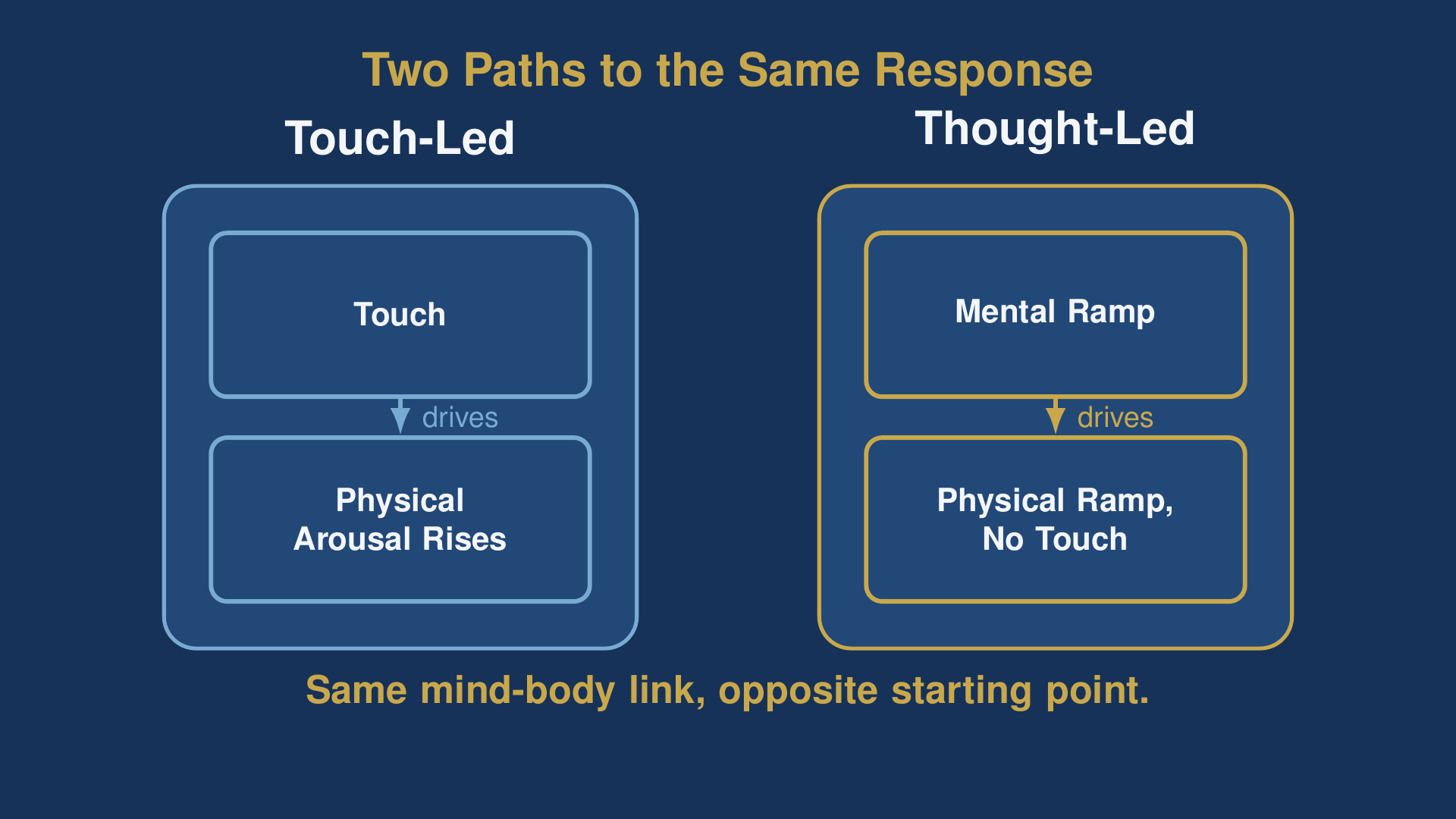
You don’t need incense or a script. You need privacy, a trigger that already works on you, and the patience to wait for a signal you didn’t manufacture. Seven steps, and you can run them tonight.
What you need: 15 to 20 minutes alone, and at least one thing you already know reliably turns you on to picture: a memory, a fantasy, or something you’ve read or watched. It has to be something that moves you on its own, before you decide anything about it.
- Get comfortable with your hands off your body entirely. Lie down or sit somewhere private and keep both hands away from your genitals for the whole exercise. No touching is the one rule that separates this from edging.
- Slow your breathing before you start. Deep, slow breaths lower your baseline tension, which makes it easier to notice the minute something shifts.
- Feed your mind a real trigger and wait for it. Picture or recall whatever reliably works for you, in as much sensory detail as you can hold. Don’t perform arousal. Let it come to you.
- Catch the mental ramp event. The moment the scene in your head suddenly feels sharper, more urgent, more real, that’s it. You’ll recognize it once it happens, and it gets easier to spot after the first time.
- Let the involuntary physical response happen without touching. A tightening, a shift in breathing, a small twitch: all of it counts. What matters is that it arrives on its own, like a reflex.
- Add a light PC pulse at the peak of each wave. As the response builds, add a gentle pelvic-floor squeeze, lighter than a full Kegel hold. This opens what the book calls a secondary outlet, and can carry more of the mental signal into a physical one.
- Ride it in waves instead of chasing one big peak. If the sensation fades, go back to feeding your mind a trigger. Several smaller waves compound better than straining for one large one.
That squeeze in step six is the one detail every breathing-and-energy account skips, and it’s the detail my own log kept circling: a hard PC squeeze with focus on the muscle, then release, is what turned a vague hit of arousal into something worth paying attention to. The muscle is the gate the signal passes through on its way to becoming a physical event.
Expect It to Work Unevenly at First
The book’s own cited research on this says fantasy and imagery alone produce a weaker, less consistent physical response than direct stimulation does, and nothing here overturns that. Expect this to work less reliably than edging with your hand, especially the first several times. Some sessions the mental ramp event never shows up at all. What those sessions show you is the gap between mental arousal and physical arousal: the two are linked, and one can still outrun the other by a long way.
Whether what you feel doing this counts as a full orgasm rather than a strong arousal peak is a definitional argument sexologists still have, and I’m not settling it here. Call it what it feels like to you. I’ve written more about the related split between orgasm and ejaculation, and the same fuzziness applies to a touch-free peak. What matters more than the label is whether the peak was real, and whether you can reach it again.
None of that makes the thinking off technique a novelty. It makes it a skill with a learning curve, like everything else on this site that asks you to detect something subtle in your own body. The first several attempts teach you what a mental ramp event feels like from the inside. Reliability comes from reps.
Arousal Arrives With Your Hands Nowhere Near You
The first time this produces an involuntary response with your hands nowhere near your body, you’ll know it immediately. It doesn’t feel like something you willed into existence. It feels like something your body did on its own, because it did.
Your mind alone can produce a physical event, and that is worth sitting with for a minute. Every time you assumed your arousal came from your hand, you were counting half the system. The mental half was there the whole time, doing less work than it’s capable of.
Catching it once tells you the wiring is real.
What you do with it across a full session, and across weeks of practice, is the bigger question, and a more useful one than whether it worked tonight.
The free email series takes this one layer down: where arousal comes from before you touch anything, where it goes once you have it, and why the two so often come apart on you. That gap is what a no-touch session is training.
Catching one no-touch peak is a small thing next to holding that state across a whole session, and holding it is where this gets interesting: what an ordinary trigger hours later, a woman two seats away on the train, can do to a body that has been carrying tension since morning. There’s a ceiling on no-touch work too, a range that keeps you responsive and beyond which you go numb to your own triggers, and most men run through it without noticing. I wrote the book for both: years of my own logs worked out into a model you can run on yourself.