Stimulate yourself, or have your partner do it, until you’re right on the edge of finishing. Stop completely, take your hand off, and wait for the urge to pass. Then start again. Repeat that a few times before you let yourself finish. That’s the premature ejaculation start stop technique on nearly every page that teaches it, word for word.
Stopping isn’t what does the work. What decides whether the pause lowers your arousal is what your pelvic floor is doing while you wait. Leave it alone and arousal drains on its own schedule, if it drains much at all. Relax it at the same moment your hand comes off and it drops fast, and a controlled comparison trial measured that gap directly.
Running the Premature Ejaculation Start Stop Technique Right
The version below adds one motion to the instruction you already know: your pelvic floor opens at the same instant your hand stops. You need to know which muscle that is before you start, and one deliberate stop mid-flow at the toilet will tell you which one it is.
- Find the release with no arousal in the room. Gently relax and slightly expand your PC muscle: the motion you would use to make yourself pee faster. Hold that about five seconds, then let go, and keep your abs, glutes and thighs out of it entirely. This reverse Kegel needs to be familiar before you ever try it mid-session.
- Build up as usual. On your own or with a partner, staying attentive as you go so you can feel where you are on the climb rather than arriving at the top by surprise.
- Catch the flutter early. Low in your pelvic floor, a small involuntary tremor shows up before the full feeling of being about to finish does. That tremor is your cue to stop, the same signal behind the catch-and-release timing skill, and it gives you a much wider window than the urge does.
- Stop and relax at the same instant. Your hand comes off and your PC muscle opens on the same beat, right as the tremor hits.
- Hold the muscle open through the pause. Keep it soft and slightly expanded for the whole wait, the same release you rehearsed on the floor at home. Tensing up and sitting there leaves your arousal idling at its own pace.
- Start again once arousal has visibly eased. Repeat two to four times before you let yourself finish, if that’s the goal for the session.
- Treat a miss as information. Stopping with no tremor to catch, or stopping once the full urge has already landed, each teach you where your timing currently sits. Adjust on the next round.
None of this replaces the version you already know; it fills in the moment your hand comes off, which the standard instruction leaves empty.
Why Taking Your Hand Away Isn’t the Same as Braking
Physical arousal runs on more than stimulation. Spontaneous erections happen with no touch involved at all, so your hand leaving can’t be what does the braking. Something else has to be doing it.
That something is the mind-body connection, and it doesn’t switch off the second your hand does. Picture two balls tied together by a length of string, one for your mind and one for your body. You can move one without the other following right away, but the further they pull apart, the tighter the string gets, until the stationary ball gets yanked along whether it wants to or not. Your hand coming off doesn’t cut that string. Your mind keeps pulling on your body for a few more seconds, sometimes longer.
A bike wheel, flicked hard and let go, doesn’t stop when your hand leaves it. It keeps spinning on its own momentum, slowing gradually from friction alone, and on a well-oiled hub that can take a while. Lifting your hand away only stops adding speed. It doesn’t touch the speed that’s already there.
Grabbing the rim is a separate, active move, and it’s the only thing that stops the wheel on the spot.
Letting your pelvic floor open in the same instant your hand lifts is grabbing the rim, and it’s also why practicing the release over and over raises the point where your body would override you regardless of what your hand is doing.
Even the felt urge the pause is timed against makes a poor countdown. Your body senses the gap between how aroused your mind is and how aroused your body is, and generates the feeling of imminent finishing trying to close it. That reading of the mind-body model is mine. The book doesn’t discuss the start-stop technique by name, only the underlying relationship between stimulation and arousal this explanation is built from.
What the Comparison Trial Found
The plain version has data behind it. A randomized trial comparing start-stop exercises against a waitlist control found a large improvement in premature ejaculation symptoms for the men who practiced it, so the basic instruction holds up.
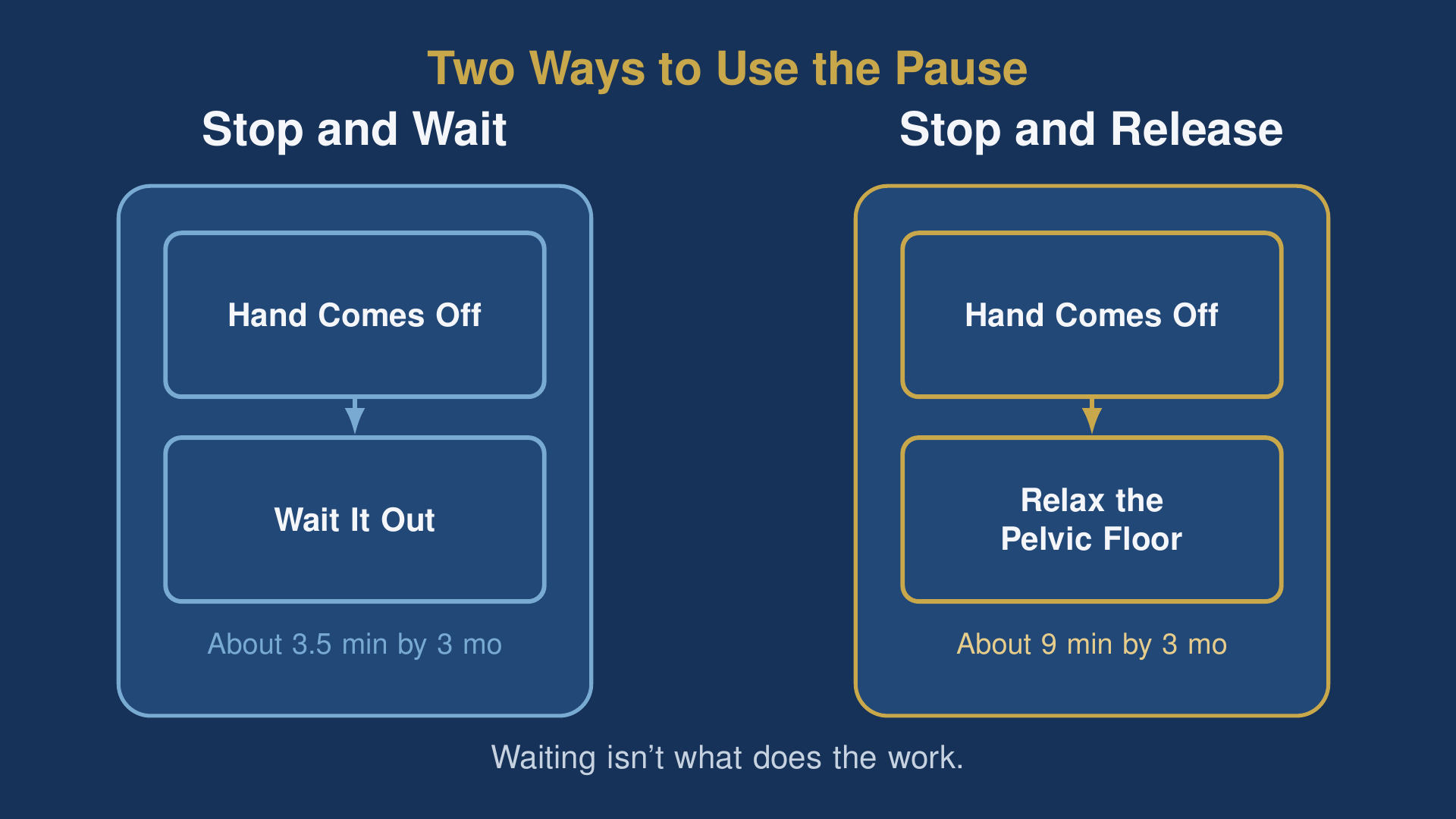
The gap shows up in a separate trial that compared two versions of the same base technique directly. Forty men practiced plain stop-start. Another forty practiced stop-start plus structured training in relaxing the pelvic floor during the pause. The group trained to engage the muscle gained roughly triple the time, up to about nine minutes of average latency against about three and a half for stop-start alone, and scored significantly better on ejaculatory-control measures at three months. Both groups started in the same place, at around half a minute.
What that trial ran was a six-session sphincter-control program bundled with stop-start over three months. The single instant of relaxing as your hand comes off has never been isolated and tested by itself, so how much of the gap that one motion carries is an open question.
Not every added ingredient moves the number. A different trial added psychological support and mindfulness on top of the same stop-start base, and it didn’t beat plain stop-start on timing itself, only on anxiety around sex. The muscle work is the ingredient that showed the gap.
This is aimed at finishing that’s driven mainly by attention and timing. If nothing has moved after weeks of practice, or the pattern has been there since the first time you tried, that’s worth a doctor’s visit.
Where the Pause Falls Apart
Two things break this pause more often than anything else.
The first is waiting with your pelvic floor doing nothing. Your hand comes off, and you wait, arms at your sides, until the feeling passes. Sometimes it does, slowly, because momentum bleeds off eventually even with no help. Often it doesn’t drop much before your body drags you back toward the edge, and you’ve spent thirty seconds or a minute for very little. The pause isn’t doing anything wrong. It’s doing nothing at all.
The second is timing the stop off the wrong signal. Most men wait for the full, unmistakable feeling of being about to finish before they stop, and by then you’re already close to the point where your body can override you regardless of what your hand does. The tremor hands you a window with room in it, and it costs nothing to stop a little early. The urge tends to arrive once that window has mostly closed, which is why stopping on it can feel like the pause barely helped.
Both failures look identical from the outside: you stopped, you waited, and it bought you very little. One of them means the muscle sat idle for a minute. The other means the pause started too late to matter.
The Pause Gets Shorter, Not Longer
Once the pause is something you’re doing instead of something you’re enduring, the wait each one needs starts to shrink. You’re bringing arousal down yourself, and that gets faster the more times you’ve rehearsed the release on the floor at home. The version that feels like a chore is the one where every pause runs as long as the first one did.
Timing one pause is a single skill. What drives your arousal up before you ever reach the edge, and what brings it back down, is a wider picture than any one pause covers, and the free email series builds it from the ground up.
The pause above is one grab of the rim. Reading the climb well enough to know you’re near the edge before the tremor even shows, and stringing pause after pause across a session without wearing yourself down by the third one, is a longer project. That project is what my book works through: five years of experiments run on myself and written up so you can follow the reasoning yourself.